Part 7: Screenplay Rewriting and Script Development
By Bhavesh Rathod · Published 2026-07-21 · Industry Insights
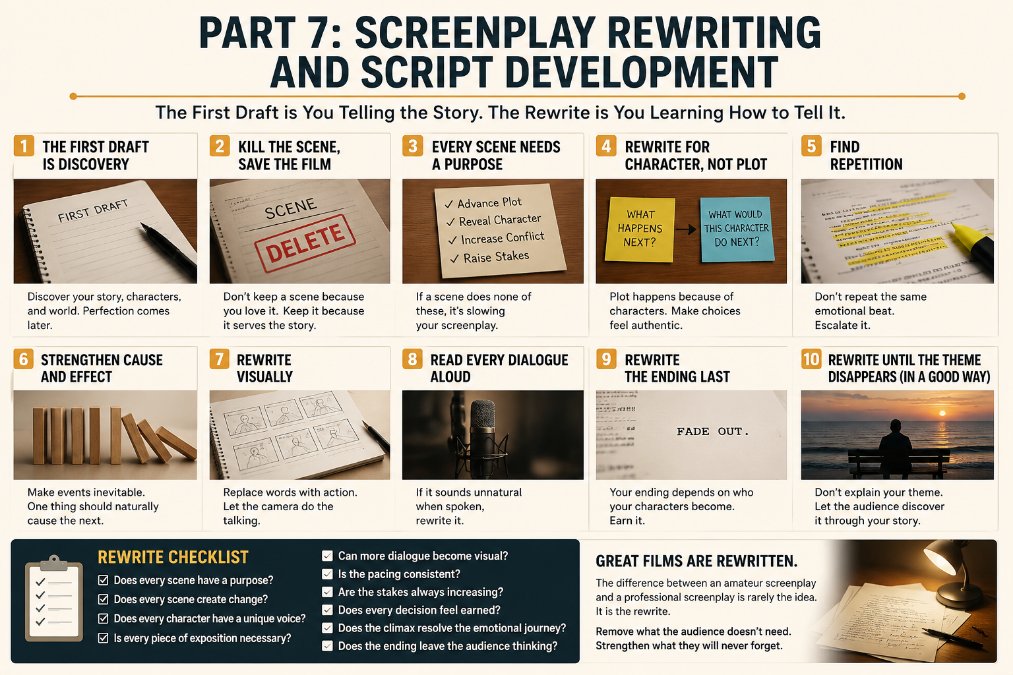
"The first draft is you telling the story to yourself. The rewrite is learning how to tell it to the world."
Most aspiring screenwriters believe that once they type "FADE OUT", the job is done. In reality, the first draft is just the raw material.
Professional screenwriters don't sell first drafts-they sell rewrites. They restructure, refine, and challenge every scene until the narrative feels emotionally inevitable. Great films are rarely written in a single burst of genius; they are built through rewriting.
1. The First Draft is Discovery
Do not expect perfection from your first draft. Its sole purpose is to help you discover what you actually have. While writing it, you figure out:
- Who your characters really are behind their initial concepts.
- What the story is truly about underneath the plot mechanics.
- Which scenes earn their place and which ones only sounded good in your head.
A first draft gives you permission to explore. The rewrite is where actual storytelling begins.
2. Kill the Scene, Save the Film
One of the hardest lessons for any writer is cutting a scene they personally love.
The Rule: Never keep a scene just because the writing is beautiful. Keep it only if it serves the story.
Ask yourself:
- Does this scene alter the direction of the story?
- Does a character make a consequential choice?
- Does it raise the tension or deepen the emotion?
- Would the audience feel lost if it were completely removed?
If the answer is "No," cut it without mercy. Great writers are ruthless editors.
3. Every Scene Needs a Purpose
Every single scene must justify its existence. It should accomplish at least one of the following:
- Advance the plot.
- Reveal a hidden layer of character.
- Escalate the central conflict.
- Raise the stakes.
- Shift a relationship dynamic.
If a scene accomplishes none of these, it is simply dragging the movie down. Beautiful scenes without purpose are just expensive filler.
4. Rewrite for Character, Not Just Plot
Amateurs spend all their rewriting energy fixing plot mechanics. Professionals rewrite character behavior.
Instead of asking, "What needs to happen next?" Ask, "What would this specific character authentically do next in this situation?"
Characters should never be puppets driven by the plot. The plot must be the natural consequence of the choices characters make.
5. Spot and Eliminate Repetition
First drafts often hit the same emotional beat multiple times. For example:
- Three separate scenes where characters argue about the exact same issue.
- Multiple conversations that arrive at the same conclusion.
Instead of repeating an emotional state, escalate it. Every new scene must dig deeper or push harder than the one before it.
6. Strengthen Cause and Effect
Weak screenplays feel like a series of random events (A happens, then B happens, then C happens).
Strong screenplays run on tight cause-and-effect:
Because A happened... B became unavoidable. Because B happened... C was inevitable.
When events trigger one another naturally, the story gains momentum and feels grounded.
7. Rewrite Visually (Show, Don't Tell)
First drafts rely heavily on dialogue to explain things. During your rewrite, challenge the text:
- Can this line of dialogue be turned into an action?
- Can this heavy piece of exposition become a single visual frame?
- Is silence more powerful than a long speech here?
Cinema is an image-driven medium. Replace words with behavior whenever possible.
8. Read All Dialogue Out Loud
Dialogue that looks great on the page can sound stiff or unnatural when spoken by actors. Read every scene aloud and listen for:
- Characters all sounding like the writer instead of distinct people.
- Speeches that feel bloated or preachy.
- Unnatural phrasing that trips up the tongue.
If two characters could swap lines without anyone noticing, rewrite them until each voice is unmistakable.
9. Rewrite the Ending Last
Don't rush to polish your climax too early. Your ending relies entirely on who your characters become through the middle of the story. Once Act 2 changes, the ending naturally shifts with it. A powerful ending isn't manufactured-it's earned by everything preceding it.
10. Rewrite Until the "Message" Disappears
Never preach your theme through direct dialogue. Let the audience discover it through the characters' actions and consequences.
The best screenplays don't tell viewers what to think; they make viewers feel something and draw their own conclusions. When your characters live truthfully, the theme takes care of itself.
🛠️ The Rewrite Checklist
Before considering your screenplay finished, run it through this filter:
- [ ] Does every scene have a clear purpose?
- [ ] Does every scene create a shift in momentum or emotion?
- [ ] Does each character have a distinct voice and vocabulary?
- [ ] Have you cut all non-essential exposition?
- [ ] Have you converted as much dialogue into visual storytelling as possible?
- [ ] Is the pacing tight, with escalating stakes?
- [ ] Is the ending a direct, earned result of the character's journey?
Conclusion: Great Films Are Rewritten
The gap between an amateur script and a professional one is rarely the core idea-it's the quality of the rewrite.
A screenplay doesn't reach perfection when there is nothing left to add, but when there is nothing unnecessary left to remove.
Coming Next: Part 8 – Theme, Symbolism, and Subtext: Writing Stories That Stay With the Audience