Why Most Agile Transformations Fail (And What No One Tells You)
By Anshul Gupta · Published 2026-04-01 · Operations & Management
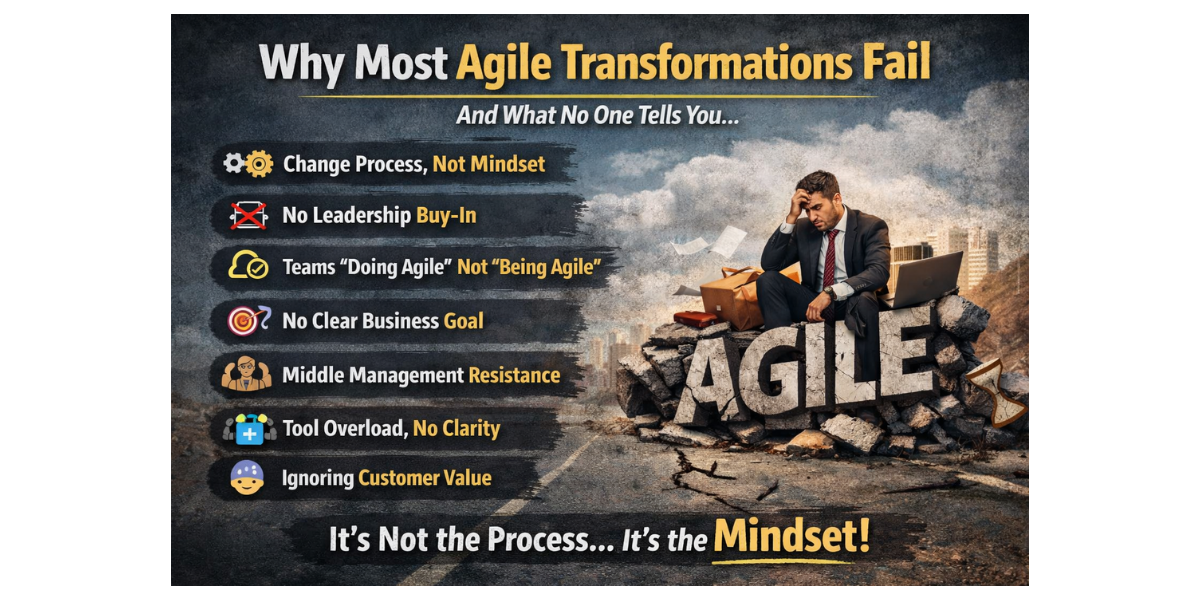
The Story That Sounds Familiar…
Three years ago, a large company decided to “go Agile.”
They hired consultants.
They trained teams.
They started daily stand-ups.
They even renamed project managers to Scrum Masters.
Six months later?
- Deadlines were still missed
- Teams were frustrated
- Leadership was confused
- Customers saw no real improvement
And quietly… the organization went back to old ways. No announcement. No failure report. Just silence. If this sounds familiar, you’re not alone.
70–80% of Agile transformations fail to deliver real business value.
But here’s the real problem:
Most people don’t understand why.
The Biggest Myth About Agile
Let’s clear this first.
Agile is not:
- Daily stand-ups
- Sprints
- Jira boards
- Scrum ceremonies
Those are just tools and practices.
Agile is actually a mindset shift from control to collaboration, from output to outcomes.
And this is exactly where most transformations break.
7 Real Reasons Why Agile Transformations Fail
Let’s go deeper with real-world examples you’ll instantly recognize.
1. They Change the Process, Not the Mindset
Most companies adopt Agile like a checklist:
- “Start stand-ups”
- “Do sprint planning”
- “Use Scrum”
But nothing really changes.
Example:
A team starts daily stand-ups…
But instead of collaboration, it becomes a status reporting meeting to the manager.
That’s not Agile. That’s old culture in new clothes.
2. Leadership Doesn’t Truly Buy In
This is the #1 hidden reason.
Leadership says:
“We want Agile”
But behaves like:
“We want control, predictability, and fixed plans”
Example:
Leaders still demand:
- Fixed deadlines
- Fixed scope
- Detailed upfront plans
That’s Waterfall thinking inside Agile.
Agile cannot survive without a leadership mindset change.
3. Teams Are “Doing Agile” But Not “Being Agile”
This is subtle but critical.
Doing Agile = following ceremonies
Being Agile = adapting, learning, improving
Example:
A team runs sprints perfectly…
But never:
- Improves processes
- Learns from retrospectives
- Adjusts based on feedback
They are busy… but not effective.
4. No Clear Business Goal
Many transformations start with:
“We want to be Agile”
But why?
- Faster delivery?
- Better quality?
- Customer satisfaction?
No one knows.
Example:
An organization spends months implementing Agile tools…
But cannot answer:
“What business problem are we solving?”
Result: Activity without impact.
5. Middle Management Resistance
This is the silent killer.
Agile changes power structures:
- Managers → Coaches
- Control → Empowerment
Not everyone is comfortable with that.
Example:
A manager still:
- Assigns tasks
- Micromanages work
- Approves every decision
Teams lose ownership → Agile fails.
6. Too Many Tools, Not Enough Clarity
Companies often think tools = transformation.
- Jira
- Confluence
- Dashboards
- Reports
But tools don’t create agility.
Example:
Teams spend more time updating tools than delivering value.
Agile becomes process-heavy instead of value-driven.
7. Ignoring Customer Value
Agile is supposed to be customer-first.
But many teams focus on:
- Completing tasks
- Closing tickets
- Meeting sprint goals
Instead of:
Delivering real value to customers
Example:
A team delivers all planned features…
But customers don’t use them.
That’s success on paper, failure in reality.
The Real Truth About Agile Transformation
Here’s the uncomfortable truth:
Agile doesn’t fail.
Transformations fail because organizations don’t actually change.
They try to:
- Keep old culture
- Keep old mindset
- Keep old structures
And just add Agile on top.
That never works.
What Successful Agile Transformations Do Differently
Let’s flip the story.
Organizations that succeed focus on:
1. Start with “Why”
They clearly define:
- What problem are we solving?
- What outcome do we want?
Example:
“Reduce delivery time by 30%”
“Improve customer satisfaction score”
2. Leadership Leads the Change
Leaders:
- Empower teams
- Accept uncertainty
- Focus on outcomes
They don’t just approve Agile - they live it.
3. Focus on Culture, Not Ceremonies
They build:
- Trust
- Collaboration
- Continuous improvement
Instead of just:
- Meetings
- Processes
4. Measure What Matters
They track:
- Customer value
- Cycle time
- Business impact
Not just:
- Velocity
- Story points
5. Think Long-Term, Not Quick Fix
Agile transformation is not a 3-month project.
It’s a multi-year cultural evolution.
A Simple Analogy (That Explains Everything)
Agile transformation is like going to the gym.
You can:
- Buy new clothes
- Join a fancy gym
- Watch workout videos
But unless you:
- Change habits
- Stay consistent
- Improve daily
- Nothing changes.
Same with Agile.
Final Thoughts
Most Agile transformations fail because:
They focus on how teams work
Instead of
how the organization thinks
One Line to Remember:
“Agile is not something you implement. It’s something you become.”
If you’re planning an Agile transformation - or already in one -
pause and ask:
“Have we changed the mindset… or just the process?”
That answer will tell you everything.