When Management Stops Managing: The Quiet Automation of Operations
By annushree279000 · Published 2026-05-02 · Operations & Management
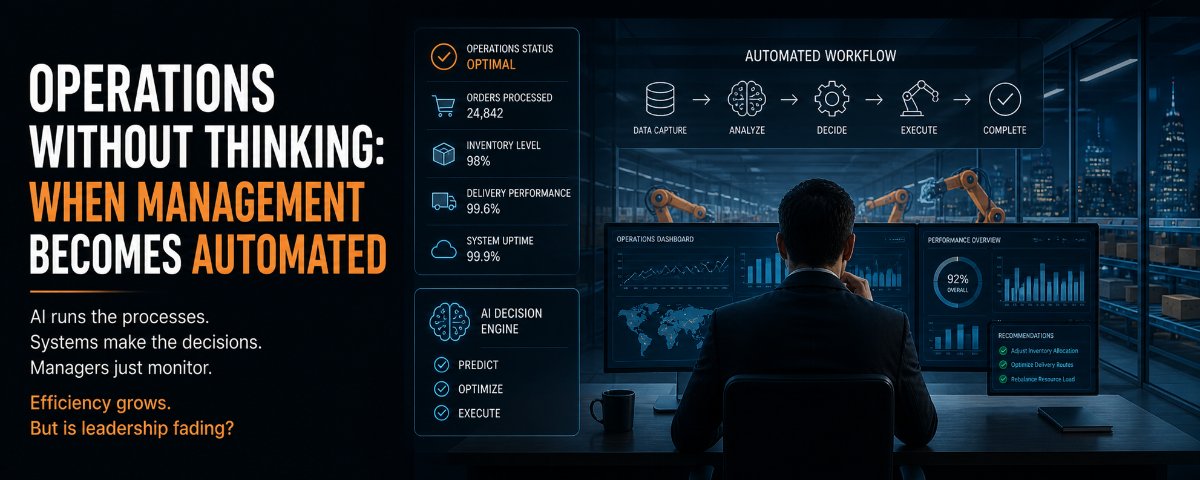
There was a time when operations and management were built on judgment.
Managers observed patterns, made decisions based on experience, handled uncertainty, and adapted to situations that had no clear answers. Operations were not just systems. They were human-driven processes shaped by context, intuition, and responsibility.
Today, that is changing.
Artificial intelligence is not just supporting operations anymore. It is starting to run them.
And in doing so, it is quietly changing what management actually means.
The Rise of Automated Operations
Modern businesses are increasingly built on systems that manage themselves.
Inventory adjusts automatically based on demand predictions. Supply chains optimize routes in real time. Customer queries are resolved without human involvement. Performance dashboards update continuously, offering recommendations before managers even ask for them.
On the surface, this is efficiency at its best.
Fewer delays. Fewer errors. Faster execution.
Operations are becoming smoother, more predictable, and less dependent on constant human oversight.
But something important is shifting beneath that smoothness.
Decision making is moving away from people.
When Management Becomes Monitoring
As AI takes over operational decisions, the role of managers begins to change.
They are no longer making as many decisions as they used to. Instead, they are reviewing outputs, approving suggestions, and monitoring systems.
The job becomes less about thinking and more about overseeing.
This creates a subtle but significant shift.
A manager who once solved problems now confirms solutions generated by a system.
A leader who once navigated uncertainty now works within structured recommendations.
Over time, this can reduce the depth of involvement in decision making.
The Illusion of Control
One of the most overlooked aspects of AI-driven operations is the illusion of control.
Managers still feel in charge. They have dashboards, insights, and recommendations at their fingertips. Everything appears transparent and data driven.
But in reality, many of the core decisions are already being shaped by algorithms.
The system suggests what to do.
The human approves it.
And over time, approval becomes routine.
When decisions are consistently guided in one direction, questioning them becomes less frequent. Trust in the system grows, but understanding of the process may decline.
The Risk of Passive Leadership
When management becomes heavily automated, there is a risk that leadership becomes passive.
If systems are always optimizing, always suggesting, always correcting, managers may begin to rely on them without deeper evaluation.
This can lead to a form of disengagement.
Not because managers are incapable, but because the system reduces the need for active thinking.
Over time, this creates a dependency.
And dependency can weaken decision making skills.
Efficiency Without Awareness
AI-driven operations are incredibly efficient.
But efficiency does not always mean awareness.
Systems optimize based on data and predefined objectives. They do not fully understand context in the human sense. They do not question whether the objective itself is right.
For example, an AI system may optimize for cost reduction, but overlook long-term brand impact. It may improve speed, but reduce customer experience in subtle ways.
These are decisions that require judgment beyond data.
If managers rely entirely on automated systems, these nuances can be missed.
Redefining the Role of Management
This does not mean that management is becoming irrelevant.
It means that its role is changing.
Managers are no longer just decision makers. They are becoming interpreters of systems, guardians of context, and evaluators of outcomes.
The challenge is to stay actively engaged.
To not just accept what the system suggests, but to question it.
To not just monitor performance, but to understand what drives it.
To not just optimize processes, but to consider their broader impact.
The Balance Between Control and Trust
AI in operations is not something businesses can ignore.
It brings undeniable advantages. It reduces inefficiencies, improves accuracy, and allows companies to scale in ways that were not possible before.
The key is balance.
Too little trust in AI leads to inefficiency.
Too much trust leads to loss of control.
Effective management in this new environment requires both.
Trusting the system enough to benefit from it, but remaining critical enough to guide it.
A New Kind of Leadership
The future of operations and management will not be defined by how well systems perform alone.
It will be defined by how well humans work alongside those systems.
Leadership will require a different kind of awareness.
Not just understanding people, but understanding technology.
Not just making decisions, but knowing when to override them.
Not just following data, but questioning it.
Conclusion
Artificial intelligence is transforming operations into highly efficient, self-optimizing systems.
But in the process, it is also reshaping management.
When systems take over decision making, managers risk becoming passive observers instead of active leaders.
The challenge is not to resist automation, but to remain present within it.
Because operations can be automated.
But responsibility cannot.