Retrieval-Augmented Generation (RAG) vs. Long-Context LLMs
By Anshul Gupta · Published 2026-04-28 · Technology & Innovation
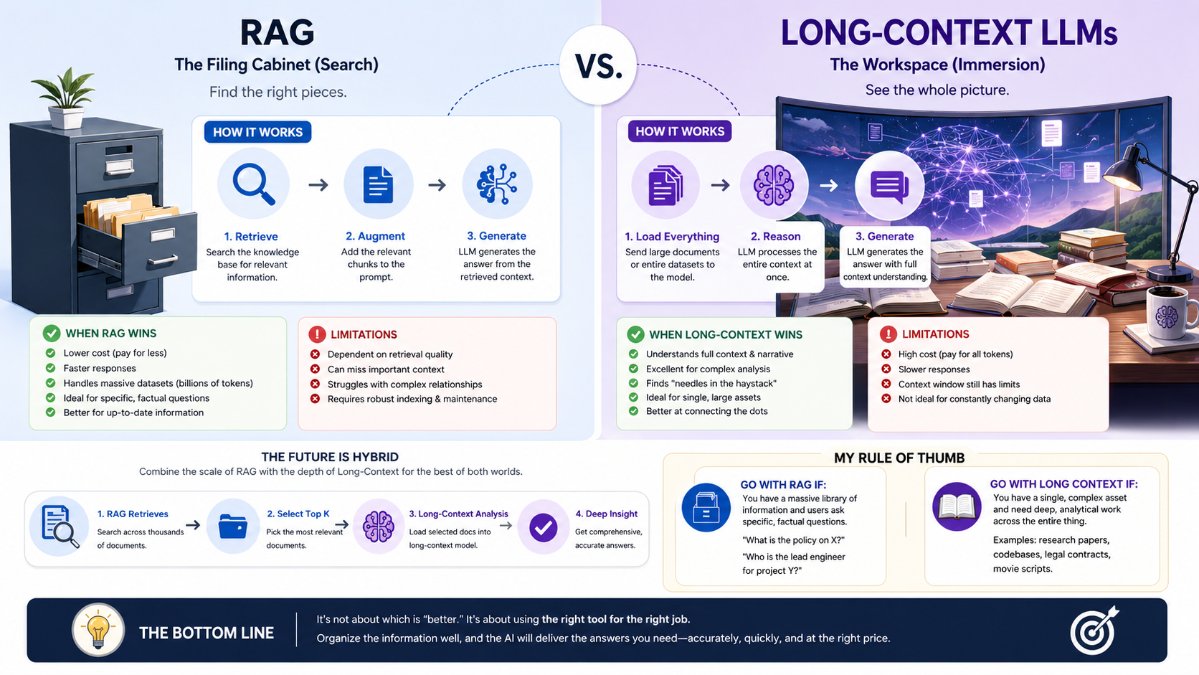
The tech world loves a good "death match," and lately, the battleground is Retrieval-Augmented Generation (RAG) vs. Long-Context LLMs.
For a while, RAG was the undisputed heavyweight champion for anyone dealing with large datasets. But as context windows have exploded with models now able to "read" millions of tokens in one go, many are wondering if RAG is becoming a relic of a more limited era.
After building with both, I’ve realized it’s not about which one is "better." It’s about understanding the difference between a filing cabinet and a workspace.
The Core Concept: Search vs. Immersion
To understand the difference, imagine you’re writing a biography of a famous historical figure.
- RAG (The Filing Cabinet): You’re in a massive archive. You have a search engine that helps you pull out ten specific folders based on keywords. You read those folders and summarize them. It’s fast and targeted, but if the search engine doesn't find the "right" folder, you’ll never see the info.
- Long Context (The Workspace): You have a giant, magical desk. You can lay out 500 books at once, and you have the brain power to look at all of them simultaneously. You don't need to search; you just know where everything is.
When RAG Still Wins: Scale and Dollars
Despite the hype around massive context windows, RAG isn't going anywhere. Here is why I still lean on it for most enterprise projects:
1. The "Million Dollar" Problem
Every time you send a prompt to a Long-Context LLM, you pay for every single word in that window. If you’re feeding it 1 million tokens ($5-$10 per hit) just to ask, "What was our Q3 revenue?", you’re burning money. RAG pulls only the relevant 500 words, costing you fractions of a penny.
2. Speed and Latency
Long-context models are brilliant, but they are "heavy." Processing a massive amount of data takes time, sometimes 30 to 60 seconds for a response. In a customer-facing chatbot, that's an eternity. RAG is snappy because the LLM is only looking at a tiny sliver of data.
3. The "Infinite" Factor
Even a 10-million token window has a limit. Most company knowledge bases (Slack logs, documentation, emails) are billions of tokens. You simply can't fit a whole company into a context window. You need a retrieval system to act as the gatekeeper.
When Long-Context is the Superior Choice
There are times when RAG feels clunky and insufficient. If your task requires "connecting the dots," Long-Context is the clear winner.
1. Complex Narrative Analysis
If you ask an AI, "How does the tone of this legal contract change from the preamble to the final appendices?", RAG will likely fail. It will pull a chunk from the start and a chunk from the end, but it misses the transition. Long-context models "feel" the flow of the entire document because they see the whole thing at once.
2. The "Needle in a Haystack"
RAG depends on embeddings - mathematical representations of meaning. Sometimes, the information you need is a tiny, weird detail that doesn't "look" like the rest of the text, so the search engine ignores it. A long-context model doesn't need to search; it scans the whole haystack and finds the needle every time.
My Personal Rule of Thumb
If you're stuck deciding which path to take for your next project, here is how I break it down:
- Go with RAG if: You have a massive library of information and your users are asking specific, factual questions (e.g., "What is the policy on X?", "Who is the lead engineer for project Y?").
- Go with Long Context if: You are working with a single, complex asset (a 200-page research paper, a massive codebase, or a full-length movie script) and you need to perform deep, analytical work across the entire thing.
The Future is Hybrid
Imagine an AI that uses RAG to sift through 100,000 documents, identifies the 20 most relevant ones, and then opens those 20 documents in a Long-Context window to perform a deep-dive analysis. This gives you the scale of a library with the focus of a scholar.
We’re moving away from asking "Which model is better?" and toward "How do I best organize the information for the AI to see?" Whether you use a filing cabinet or a giant desk, the goal remains the same: getting the right answer at the right price.