When Your Best Employee Is an Algorithm
By annushree279000 · Published 2026-05-01 · Finance & Business
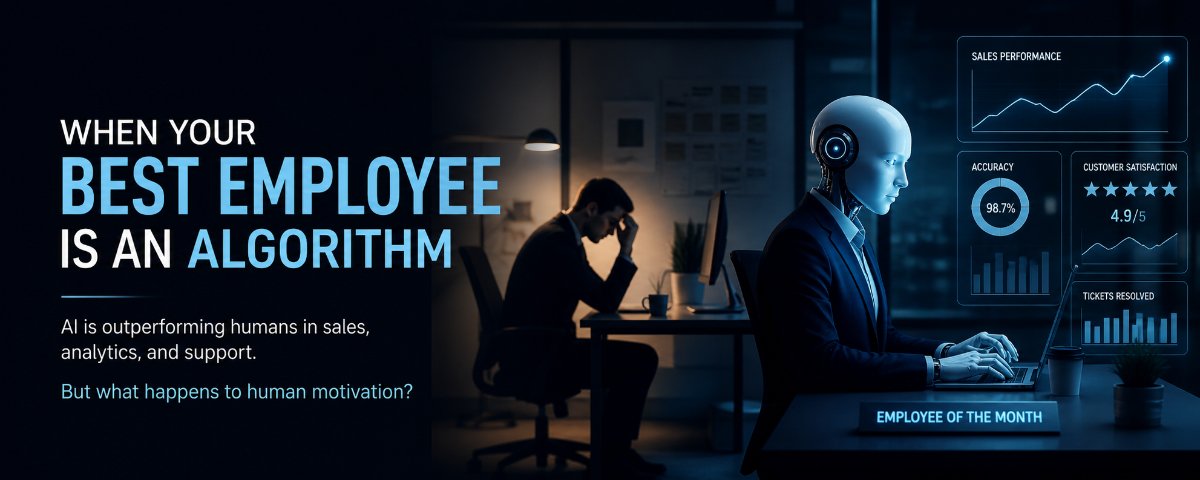
There was a time when being the best employee meant something visible.
It meant staying late, solving problems faster than others, understanding customers better, and delivering results that stood out. Performance had a face, a name, a presence in the room.
Today, that idea is quietly changing.
In many businesses, the highest performing “employee” does not attend meetings, does not take breaks, and does not even exist as a person. It is an algorithm.
And it is getting better at the job.
The Quiet Shift in Performance
Artificial intelligence has moved beyond support roles. It is no longer just assisting employees. It is beginning to outperform them.
In sales, AI systems analyze customer behavior and predict buying patterns with a level of precision that humans struggle to match. In analytics, algorithms process vast amounts of data in seconds, identifying trends that would take teams days to uncover. In customer support, AI handles conversations instantly, often with consistency that does not fluctuate with mood, fatigue, or stress.
The change is not dramatic or loud. It does not arrive with a clear announcement. Instead, it happens gradually.
A task gets automated.
A report gets generated faster.
A chatbot resolves more queries than a human team.
Over time, the comparison becomes unavoidable.
The Redefinition of “Best”
When an algorithm consistently delivers better results, the definition of excellence begins to shift.
Being “the best” is no longer about outperforming colleagues. It becomes about competing with a system that does not experience limits in the same way humans do.
An algorithm does not feel tired at the end of a long day. It does not lose focus. It does not need motivation.
It simply performs.
For human employees, this creates a subtle but powerful tension. The standard is no longer human. It is computational.
The Psychological Impact
Work has never been only about income. It is also about identity, recognition, and a sense of contribution.
When employees see an algorithm outperforming them, it can affect motivation in ways that are not immediately visible.
Some may feel replaced, even if their roles still exist. Others may begin to question the value of their efforts. If a machine can do the same task faster and more accurately, what does that say about their own contribution?
There is also the risk of disengagement. When people feel that their work is no longer meaningful or competitive, they may stop striving to improve. Effort begins to feel less rewarding when the outcome is predetermined by a system that cannot be surpassed.
At the same time, a different response can emerge. Some employees may push themselves harder, attempting to match or exceed the performance of AI. This can lead to growth, but it can also lead to burnout.
The Illusion of Fair Comparison
It is important to recognize that comparing humans to algorithms is not entirely fair.
AI operates under fundamentally different conditions. It has access to vast data, operates at high speed, and does not carry emotional or physical limitations. Humans, on the other hand, bring creativity, empathy, and contextual understanding that are difficult to quantify.
Yet in performance metrics, these differences are often overlooked.
Numbers tend to dominate evaluation. Efficiency, speed, and accuracy are easier to measure than insight, judgment, or emotional intelligence.
As a result, the strengths of AI become more visible, while the strengths of humans become less acknowledged.
Changing Roles, Not Just Replacing Them
The rise of AI does not necessarily mean the disappearance of human roles, but it does mean their transformation.
Employees are no longer just expected to execute tasks. They are expected to interpret, supervise, and complement AI systems.
This requires a shift in mindset.
Instead of asking, “Can I do this better than the algorithm?” the more relevant question becomes, “What can I do that the algorithm cannot?”
This might include building relationships, making ethical decisions, handling ambiguity, or bringing creativity into problem solving.
The challenge is that these skills are less defined and harder to measure, which can make them feel less secure.
Motivation in a New Landscape
So what happens to motivation when your best employee is an algorithm?
It does not disappear, but it changes.
Motivation may shift away from competition and toward collaboration. Instead of trying to outperform AI, employees may begin to see it as a tool that enhances their own capabilities.
At the same time, organizations have a responsibility to redefine what they value. If success is measured only by metrics where AI excels, human motivation will inevitably decline. But if businesses recognize and reward uniquely human contributions, motivation can be sustained in a different form.
The key lies in balance.
A Subtle Redefinition of Work
The presence of AI in the workplace forces a deeper question.
What does it mean to contribute?
If productivity is no longer the sole measure of value, then work itself must be understood differently. Contribution may become less about output and more about perspective, judgment, and the ability to navigate complexity.
This is not a loss of relevance for humans. It is a shift in where relevance lies.
Conclusion
The idea that your best employee could be an algorithm would have once seemed unlikely. Today, it is becoming a reality in many industries.
This does not signal the end of human importance, but it does challenge long held assumptions about performance and value.
As AI continues to evolve, the workplace will not simply become more efficient. It will become more complex in how it defines excellence.
The question is not whether algorithms will outperform humans in certain tasks. They already do.
The real question is how humans will redefine their place in a world where being the best no longer means what it once did.