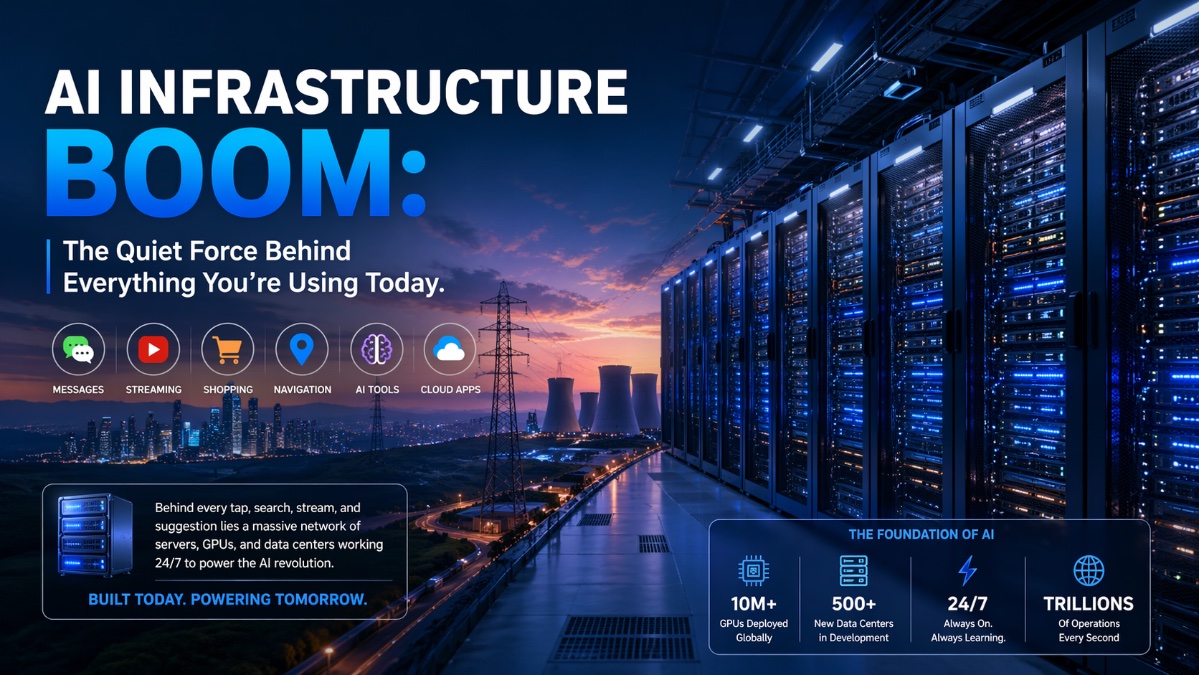
AI Infrastructure Boom: The Quiet Force Behind Everything You’re Using Today
By Anshul Gupta · Published 2026-04-23 · Technology & Innovation
A few months ago, a founder I know tried to launch an AI-powered customer support tool. The idea was solid. The interface looked clean. Early users loved it.
But within weeks, things started breaking.
Responses slowed down. Costs shot up. The system couldn’t handle more users. Eventually, they had to pause growth not because their product was bad, but because their infrastructure couldn’t keep up.
That’s when it hits you AI isn’t just about smart features or impressive outputs. There’s something much bigger underneath it all.
Something most people never see.
That “something” is the reason we’re now talking about the AI infrastructure boom.
What AI Infrastructure Really Means (Without the Jargon)
When most people think about AI, they think about tools apps that write content, generate images, or help with work.
But those tools are just the surface.
Underneath, there’s a whole system working constantly to make those experiences smooth and fast. AI infrastructure is simply the combination of hardware and systems that make all of this possible at scale.
It includes things like powerful chips, large data centers, cloud platforms, and high-speed networks.
A simple way to think about it:
You don’t think about electricity when you switch on a light. But without the grid behind it, nothing works.
AI infrastructure is that invisible grid.
Why This Boom Is Happening Now
The growth we’re seeing isn’t random it’s being driven by a few clear shifts.
First, AI models have become much larger and more capable. But with that capability comes complexity. Training and running these models requires serious computing power.
Second, AI is no longer limited to tech companies. It’s now used in healthcare, finance, education, marketing almost everywhere. Every new use case increases demand.
And third, expectations have changed. People don’t want slow AI. They expect instant responses. That pressure forces companies to invest heavily in faster, more efficient infrastructure.
A Simple Example :
Imagine you open an AI tool and ask it to:
- Write a professional email to a client
- Create a social media image for your brand
- Or generate a short video script for Instagram
You type your prompt, hit enter, and within seconds it’s done.
Feels simple.
But behind that one click, a lot is happening.
Your request travels to a remote server often located in a massive data center. There, an AI model processes your input using specialized hardware designed to handle huge workloads.
If you asked for an image:
- The system isn’t just “drawing”
- It’s generating visuals based on patterns learned from millions of examples
If it’s an email:
- It understands tone, context, and intent
- Then creates something that sounds natural and appropriate
If it’s a video script:
- It combines structure, storytelling, and clarity in seconds
Now zoom out.
It’s not just you doing this it’s millions of people at the same time, across the world.
That’s why infrastructure matters so much.
Without it, these tools wouldn’t feel fast, smooth, or reliable. You’d be waiting minutes or your request might fail completely.
The Pressure on Computing Power
One of the biggest challenges in AI today is raw computing power.
AI systems need to process massive amounts of data simultaneously. This is very different from traditional software.
Because of this, companies rely on specialized hardware that can handle parallel processing efficiently.
There have even been situations where startups had great ideas but couldn’t scale simply because they didn’t have enough computing resources.
That’s how critical infrastructure has become.
Data Centers: The Real Workhorses
Behind every AI tool is a data center.
These are huge facilities filled with servers that store data and run AI models. But they’re not your typical server rooms anymore.
Modern AI data centers are built differently. They need:
- More power
- Better cooling systems
- Faster communication between machines
Some of these facilities are so large and energy-intensive that they’ve started raising concerns about electricity usage in certain regions.
But without them, AI simply wouldn’t function at the scale we see today.
Why AI Is Expensive (Even If It Feels Free)
From a user perspective, many AI tools feel affordable or even free.
But behind the scenes, they’re costly to run.
Every time you generate an image, write an email, or create content, it uses computing resources. Multiply that by thousands or millions of users, and the costs add up quickly.
This is one of the biggest challenges for AI startups. It’s not just about building a good product-it’s about sustaining the infrastructure behind it.
How Cloud Platforms Changed Everything
Not every company can afford to build its own infrastructure. That’s where cloud platforms come in.
Instead of buying expensive hardware, businesses can rent computing power when they need it.
This has made AI much more accessible.
A small startup can now build and launch an AI product without owning a single server. They can scale up as they grow and scale down when needed.
It’s one of the main reasons why we’re seeing so many new AI products enter the market.
The Energy Challenge
There’s one issue that doesn’t get enough attention energy consumption.
AI systems require a lot of power. Training models and running them continuously consumes significant electricity.
Cooling these systems also adds to the energy load.
As AI adoption grows, this becomes a bigger concern.
Some companies are already working on solutions like:
- Using renewable energy
- Designing more efficient hardware
- Reducing unnecessary computation
But it’s still an ongoing challenge.
What This Means for Businesses
If you’re thinking about using AI in your business, infrastructure is something you can’t ignore.
It affects:
- Speed and performance
- Cost of operations
- Ability to scale
For example, if you run an online store and use AI for recommendations, your system needs to handle traffic spikes during big sales.
If your infrastructure isn’t strong enough, the experience breaks and so does trust.
What This Means for Developers and Creators
Even if you’re not building infrastructure, understanding it helps you make better decisions.
If you’re creating an AI-powered app, you need to think about:
- How efficiently it uses resources
- How it scales with users
- How much it costs to run
Ignoring these factors can lead to problems later-even if your product works well initially.
Where This Is All Heading
The AI infrastructure boom is just getting started.
We’re likely to see:
- More specialized hardware designed specifically for AI
- Faster and more efficient data centers
- Growth in edge AI (running AI closer to users instead of relying only on the cloud)
- Increased competition between companies and countries
One interesting trend is running AI directly on devices like smartphones. This could reduce reliance on large data centers and improve speed.
Final Thoughts
It’s easy to focus on what AI can do.
The tools are impressive. The results are fast. The possibilities keep expanding.
But none of it exists without the foundation underneath.
The AI infrastructure boom is not just a technical trend it’s the backbone of everything happening in AI right now.
And while it doesn’t get as much attention as flashy tools, it’s where some of the most important changes are taking place.
So the next time you generate an image, write an email, or create a video using AI, remember:
It may feel like a simple click.
But behind that click is an entire system working quietly, constantly, and at massive scale making it all possible.