How to Use Tokens Smartly in OpenAI, Claude, Gemini & Other AI Tools (Without Wasting Money)
By Anshul Gupta · Published 2026-05-28 · Technology & Innovation
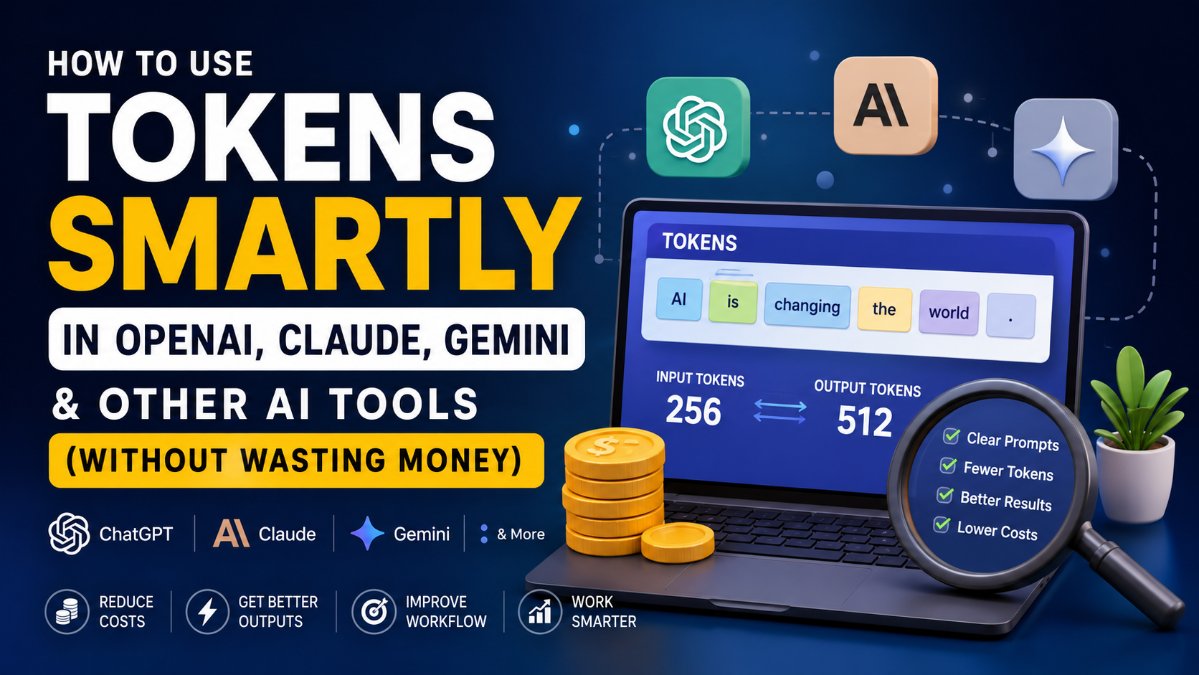
Artificial Intelligence is no longer just for developers or tech companies. Today, students, creators, marketers, startup founders, freelancers, and even small business owners use tools like ChatGPT, Claude, Gemini, and other LLMs every single day.
But there’s one thing most people still don’t fully understand:
Tokens.
And if you don’t understand tokens, you are probably:
- Spending more money than needed
- Getting worse AI responses
- Hitting context limits
- Slowing down workflows
- Confusing the model with unnecessary prompts
In today’s AI-driven world, learning how to use tokens efficiently is becoming as important as learning how to use Google 15 years ago.
This guide explains tokens in simple language, with practical examples anyone can understand.
What Are Tokens in AI?
Think of tokens as small pieces of text that AI models read and process.
A token can be:
- A word
- Part of a word
- A number
- Punctuation
- Spaces
For example:
Sentence:
“AI is changing the world.”
This may be broken into tokens like:
- AI
- is
- changing
- the
- world.
So even a small sentence uses multiple tokens.
Most AI tools charge based on:
- Input tokens (what you send)
- Output tokens (what AI replies with)
The longer your conversation, the more tokens are consumed.
Why Token Usage Matters More Than Ever
In 2026, AI tools are becoming daily work partners.
People now use AI for:
- Writing
- Coding
- Research
- Customer support
- SEO
- Marketing
- Video scripts
- Automation
- Learning
- Business operations
If you use tokens badly, AI becomes expensive and inefficient.
If you use them smartly, AI becomes:
- Faster
- Cheaper
- More accurate
- More useful
This is especially important for:
- Startups
- Agencies
- SaaS companies
- Heavy ChatGPT users
- API developers
- Teams scaling AI workflows
Biggest Mistake People Make With AI Prompts
Most users write prompts like this:
“Hey ChatGPT, I have this thing I’m working on and basically I need help because my client said the article should maybe sound professional but also casual and maybe SEO optimized and…”
This wastes tokens.
AI models don’t need emotional filler or unnecessary background.
Instead, write:
“Write a 1,000-word SEO-friendly article in a professional but conversational tone for startup founders.”
Shorter.
Clearer.
Cheaper.
Better.
Smart Prompting = Smart Token Usage
The best AI users are not the people writing the longest prompts.
They are the people writing the clearest prompts.
Good prompts:
- Reduce confusion
- Improve output quality
- Save money
- Reduce retries
Bad prompts create:
- Longer outputs
- Repeated explanations
- Wrong answers
- More token consumption
7 Smart Ways to Reduce Token Usage in AI Tools
1. Be Direct
Instead of:
“Can you maybe help me understand…”
Say:
“Explain quantum computing simply.”
Every extra sentence adds token cost.
2. Stop Repeating Context
Many users repeat the same information in every prompt.
Bad example:
“Remember my startup is about fitness apps…”
If the conversation already contains that context, don’t repeat it unless necessary.
Repeated context = repeated token usage.
3. Use Structured Instructions
AI understands structure very well.
Instead of:
“Write something about marketing.”
Use:
- Audience: SaaS founders
- Tone: Conversational
- Length: 800 words
- Goal: SEO ranking
- CTA: Newsletter signup
This improves output quality while reducing unnecessary responses.
4. Ask for Exact Length
Without limits, AI often writes too much.
Instead of:
“Explain SEO.”
Use:
“Explain SEO in 150 words.”
This saves output tokens immediately.
5. Avoid Huge Copy-Paste Dumps
One of the biggest token killers is pasting:
- Entire PDFs
- Full articles
- Massive codebases
- Long chats
Instead:
- Paste only relevant sections
- Summarize first
- Use bullet points
Good AI users curate information before sending it.
6. Use Follow-Up Prompts Instead of One Giant Prompt
Many people try to do everything in one request.
Bad:
“Write article, generate tweets, make LinkedIn post, SEO title, keywords, FAQs, email newsletter…”
Better:
- Generate article
- Then ask for social posts
- Then ask for SEO metadata
Cleaner workflow.
Better responses.
Lower confusion.
7. Use System Instructions Wisely
If using APIs or custom GPTs, set rules once instead of repeating them.
Example:
- Tone: Professional
- Avoid emojis
- Use short paragraphs
- SEO optimized
This prevents repeating instructions every time.
Different AI Models Handle Tokens Differently
Not all LLMs work the same way.
OpenAI Models
OpenAI models are excellent at:
- Structured outputs
- Coding
- Content generation
- Tool usage
But large conversations can become expensive if context grows too much.
Best practice:
- Reset chats regularly
- Keep prompts focused
- Remove unnecessary history
Claude
Claude is known for:
- Large context windows
- Long-document handling
- Research tasks
Many users misuse Claude by uploading huge files without clear instructions.
Instead of:
“Analyze this 300-page report.”
Say:
“Summarize key business risks from this report in bullet points.”
Specific prompts reduce token waste dramatically.
Gemini
Gemini works well for:
- Multimodal tasks
- Google ecosystem integration
- Research workflows
But users often overload prompts with too many objectives.
One prompt = one clear task.
That rule improves almost every LLM.
Why Long Prompts Don’t Always Mean Better Results
This is one of the biggest myths in AI.
People assume:
“More details = smarter output.”
Not always.
Too much information can:
- Distract the model
- Dilute the main goal
- Increase hallucinations
- Waste tokens
Good prompting is like good communication with humans:
Clear beats complicated.
The Hidden Cost of AI Token Waste
Most people think token waste only affects pricing.
Wrong.
It also affects:
- Response speed
- Context memory
- AI focus
- Scalability
- Automation efficiency
For businesses using APIs at scale, poor token management can cost thousands of dollars monthly.
Real Example: Bad vs Smart Prompt
Bad Prompt
“Hey, I run a digital marketing agency and I need help writing a blog for my audience and I want it SEO optimized and maybe engaging and maybe use examples…”
Token-heavy and vague.
Smart Prompt
“Write a 1,200-word SEO blog for digital marketing agency owners. Tone: conversational. Include examples and actionable tips.”
Smaller input.
Better output.
Token Efficiency Is Becoming a Real Skill
In the next few years, companies will actively look for people who know how to:
- Prompt efficiently
- Reduce AI costs
- Build scalable AI workflows
- Use context windows smartly
AI literacy is no longer optional.
And token optimization is part of AI literacy.
Best Practices for Everyday AI Users
If you remember only a few things from this article, remember these:
DO:
- Be clear
- Be specific
- Use short instructions
- Break tasks into steps
- Set word limits
- Remove unnecessary text
DON’T:
- Write emotional filler
- Paste huge irrelevant content
- Repeat instructions constantly
- Ask multiple unrelated tasks together
Final Thoughts
AI tools like ChatGPT, Claude, Gemini, and other LLMs are becoming part of daily life and business operations.
But the people who benefit most from AI will not be the people using the most tokens.
They will be the people using tokens intelligently.
Learning how tokens work gives you:
- Better outputs
- Lower costs
- Faster workflows
- Smarter automation
- Higher productivity
In today’s AI era, efficient prompting is becoming a superpower.
And honestly, this is a skill everyone should start learning now.