Part 9: Script Formatting, Pitching, and Navigating the Film Industry
By Bhavesh Rathod · Published 2026-07-21 · Industry Insights
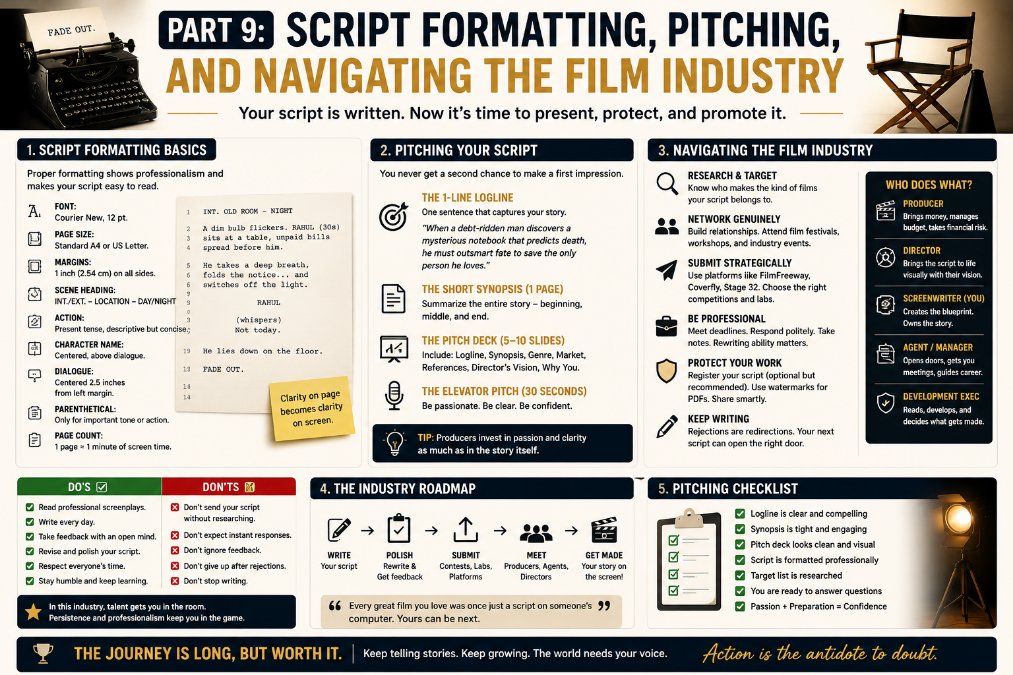
"A great story gets you in the door. Professional execution and clear pitching are what get the movie made."
You’ve rewritten your draft, polished your theme, and infused every scene with subtext. Now comes the business side of screenwriting.
No matter how brilliant your story is, if your screenplay isn't formatted properly or if you can't communicate its core idea in two minutes, industry professionals will pass. Part 9 breaks down the tools you need to present your work-and yourself-as a true professional.
1. Industry Standard Formatting (The "Unwritten Rules")
Hollywood and global film industries run on strict layout conventions. Proper formatting tells a reader, "I am a professional who respects your time."
- 1 Page = 1 Minute: As a general rule, one page of a formatted screenplay equals roughly one minute of screen time.
- The Software: Never write a screenplay in Microsoft Word or Google Docs. Use industry-standard software like Final Draft, WriterDuet, Fade In, or Highland.
- Scene Headings (Sluglines): Keep them crisp and clear: INT. COFFEE SHOP - DAY or EXT. HIGHWAY - NIGHT
- Action Lines: Write in the present tense (John walks into the room, not John walked...). Keep paragraphs short-no more than 3–4 lines-to maintain white space and fast pacing.
2. The Logline: Your 2-Sentence Hook
Before anyone reads your 110-page script, they will read your logline. A logline is a short, punchy summary of your movie's core conflict.
The Formula:
[Protagonist] + [Inciting Incident] + [Goal] + [Central Conflict/Antagonist] + [Stakes]
- Weak Logline: "A cop tries to stop a bad guy who takes over a building."
- Strong Logline (Die Hard): "An off-duty New York cop attends his estranged wife's office party, only to find himself trapped in a high-rise skyscraper seized by a ruthless group of international terrorists."
3. Crafting the Verbal Pitch
When meeting producers, directors, or executives, you’ll rarely hand them the script right away. You’ll pitch it.
- The Elevator Pitch (30–60 Seconds): The logline + the tone + the core hook. (e.g., "It's 'Jaws' in space" for Alien).
- The Full Pitch (5–10 Minutes):
- The Hook: Why this story? Why now? What makes it unique?
- The Protagonist: Who do we care about and what is their flaw?
- The World & Inciting Incident: What breaks their normal life?
- The Journey (Act 2): The major escalations and central conflict.
- The Climax & Emotional Payoff: Show them how satisfying the ending will feel without getting bogged down in scene-by-scene detail.
4. The Pitch Deck & Treatment
Producers often ask for supporting documents to visualize the film before reading or buying it:
- Treatment (3–10 pages): A prose summary of the narrative written like a short story, detailing the plot from beginning to end.
- Pitch Deck (Lookbook): A visual slide presentation containing concept art, tone references, casting ideas, character breakdowns, and thematic statements.
5. Navigating the Industry & Building a Career
Writing is a craft; screenwriting as a career is a marathon.
- Protect Your Work: Register your script with the WGA (Writers Guild) or official copyright offices before sending it out widely.
- Build a Portfolio: Never rely on just one script. Industry executives will almost always ask, "This is great, what else do you have?" Always have 2–3 polished scripts ready.
- Networking Over Cold Emails: Film is a collaborative, relationship-driven industry. Film festivals, screenwriting competitions (like Nicholl Fellowships), local filmmaking groups, and social media spaces are often where real connections start.
- Learn to Take Feedback: A professional takes notes gracefully. Separate your ego from the page-producers and directors aren't attacking you; they are trying to make the project viable.
🛠️ The Industry Readiness Checklist
Before sending your script to agents, managers, or producers, ensure:
- [ ] Is the script properly formatted using dedicated screenwriting software?
- [ ] Is it between 90 and 110 pages (for feature films)?
- [ ] Is your logline clear, intriguing, and under 30 words?
- [ ] Have you eliminated typos, grammatical errors, and orphan lines?
- [ ] Do you have a 1-page synopsis and a short pitch deck prepared?
- [ ] Is your script registered/copyrighted?
Conclusion: The Complete Screenwriter
Understanding structure, dialogue, character arcs, and theme makes you a great writer. Understanding formatting, pitching, and professional etiquette makes you a working screenwriter.
When you combine powerful storytelling with professional execution, you give your script the best possible chance of making it off the page and onto the screen.
Coming Next: Part 10 – The Complete Screenwriting Roadmap: From Concept to Screen