AI in Agile Metrics & Reporting: Why Your Dashboards Are Lying to You
By Anshul Gupta · Published 2026-04-02 · Operations & Management
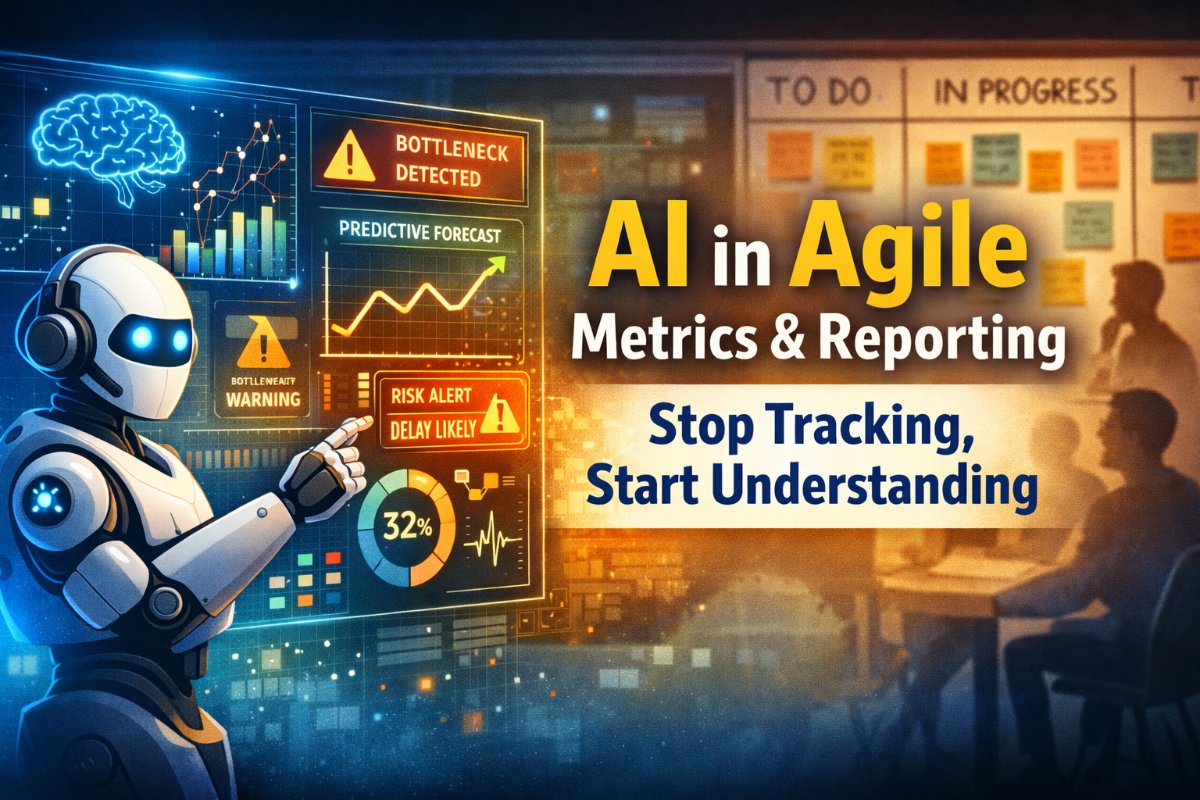
Let’s start with a scene that might feel painfully familiar.
It’s sprint review day.
The dashboard looks… perfect.
- Velocity is stable
- Burndown chart looks clean
- Sprint completed “successfully”
Everyone nods. Stakeholders seem satisfied.
And yet -
Deadlines are still slipping.
Customers are still unhappy.
The team still feels overwhelmed.
So what’s going on?
Here’s the truth:
Your Agile metrics are telling a story. Just not the right one.
The Illusion of Control
For years, Agile teams have relied on a handful of familiar metrics:
- Velocity
- Burndown charts
- Story points completed
- Sprint success rate
These numbers give a sense of control.
But let’s be honest.
They don’t answer the real questions:
- Are we building the right thing?
- Are we improving over time?
- Where are we actually stuck?
Instead, they answer safer questions:
- Did we complete what we planned?
And that’s a very different conversation.
When Metrics Become Theatre
Somewhere along the way, metrics stopped being tools for improvement…
…and became tools for reporting.
Teams start optimizing for numbers instead of outcomes.
- Inflate story points to show higher velocity
- Split tasks just to “close more tickets”
- Avoid complex work to keep charts looking clean
Everything looks better on paper.
Nothing actually gets better.
This is where traditional Agile reporting starts to break.
Enter AI: Not Another Dashboard, But a Different Lens
Most people think AI in Agile means: “Better reports” That’s not it.
AI doesn’t just show you data.
It helps you understand what the data actually means.
And more importantly: It tells you what to do next.
A Shift From Reporting → Intelligence
Let’s look at how this changes things.
Old World:
- Dashboard says: “Velocity dropped this sprint”
- Team says: “We’ll try to improve next time”
End of discussion.
New World with AI:
- AI analyzes sprint data, commits, blockers, dependencies
- It identifies patterns across multiple sprints
- It surfaces insights like:
“Velocity dropped because 3 high-dependency tasks were blocked for 2 days. This pattern has occurred in 4 of the last 6 sprints.”
Now that’s useful.
That’s not reporting. That’s diagnosis.
The Metrics That Actually Matter (But You’re Not Tracking Properly)
AI doesn’t replace metrics.
It reframes them.
1. Flow Efficiency (Not Just Velocity)
Velocity tells you how much work was done.
AI tells you:
How much time was actually spent working vs waiting
You might discover:
- Tasks spend 70% time waiting
- Only 30% in actual progress
That’s where your real problem is.
2. Bottleneck Detection (In Real Time)
Traditional reporting:
- You find bottlenecks after the sprint
AI:
- Detects bottlenecks while they’re happening
Example: “Code reviews are delaying delivery by 36% this sprint.”
Now you can act immediately.
3. Predictive Delivery (Instead of Hope-Based Planning)
Let’s be honest.
Most sprint planning is optimistic guesswork.
AI changes that.
It can predict:
- Sprint completion probability
- Risk of delay
- Impact of scope changes
You move from:
“Hope we finish”
to
“Know what will happen”
4. Team Health Signals (The Invisible Metric)
No dashboard shows:
- Burnout
- Context switching
- Overload
But AI can infer it from patterns:
- Increased cycle time
- Frequent task switching
- Drop in completion consistency
Suddenly, you’re not just managing work.
You’re managing team sustainability.
A Real Shift in Conversation
This is where things get interesting.
With traditional metrics, sprint reviews sound like this:
“We completed 28 story points. Velocity is stable.”
With AI-driven insights, it becomes:
“We’re losing 40% efficiency due to dependency delays. If we fix this, delivery speed improves without increasing workload.”
Which conversation would you rather have?
Why Most Teams Still Don’t Get This Right
Because they make one critical mistake:
They add AI on top of existing metrics… without questioning the metrics themselves.
If your foundation is flawed, AI will just make it more sophisticated - not more useful.
What Smart Agile Teams Are Doing Differently
They’re not asking: “How do we improve our reports?”
They’re asking: “What decisions are we struggling to make?”
Then they use AI to:
- Identify patterns humans miss
- Connect data across tools
- Provide actionable insights
The Future of Agile Reporting
Let’s fast-forward a bit.
In the near future:
- Dashboards won’t be static
- Reports won’t be manual
- Metrics won’t be isolated
Instead:
You’ll have systems that continuously answer:
- What’s slowing us down?
- What should we fix next?
- Are we improving or just moving?
Without you asking.
Final Thought
Agile was never about tracking work. It was about improving how we work. But somewhere, we got stuck measuring activity instead of progress. AI gives us a chance to fix that. Not by adding more metrics…but by finally understanding the ones we already have.
If You’re Leading an Agile Team…
Take a step back and ask:
“Are our metrics helping us improve… or just helping us report?”
Because in the end -
The teams that win won’t be the ones with the best dashboards.
They’ll be the ones with the clearest insights and fastest decisions.