Synthetic Intuition: When AI Starts Guessing Without Data
By annushree279000 · Published 2026-05-01 · Technology & Innovation
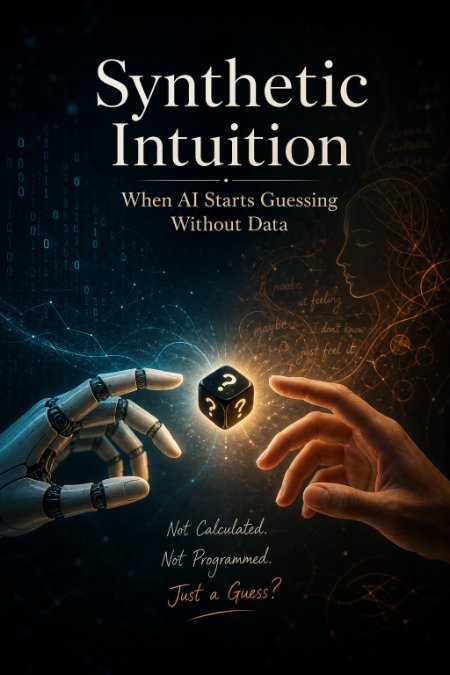
For a long time, we have taken comfort in the idea that machines are predictable. You give them data, they process it, and they return an answer. The process may be complex, but the principle feels stable. There is always a reason behind what a machine produces, even if we cannot fully see it.
That sense of order has shaped the way we trust artificial intelligence. It feels safe because it appears grounded. Every output seems to come from something that already exists, something that can, at least in theory, be traced back and explained.
But that sense of stability begins to shift when we ask a different question. What happens when artificial intelligence starts to behave in ways that feel less like calculation and more like guessing?
The Foundation of Data
Modern AI systems are built on patterns. They learn by analyzing vast amounts of information and identifying relationships within it. When an AI model generates a sentence, recommends a product, or predicts an outcome, it is drawing from patterns it has observed before.
In this sense, AI is deeply tied to the past. It does not create from nothing. It reorganizes, recombines, and extends what it has already seen.
This is precisely why it feels reliable. There is an underlying structure guiding every response. Even when the result surprises us, it still emerges from a system rooted in data.
The Human Habit of Guessing
Humans, however, operate differently. We make decisions without having complete information. We rely on instinct, on impressions, on what we often call intuition.
Intuition is not easily explained. It is shaped by memory, emotion, and subtle cues that we may not consciously recognize. At times, it leads us in the right direction. At other times, it fails us. Yet it remains one of the most defining aspects of human thought.
We do not always need a clear chain of reasoning to act. Sometimes we simply feel that something is right or wrong, and we move accordingly.
When Machines Begin to Resemble Intuition
Recent developments in AI have introduced an interesting shift. Generative models and probabilistic systems do not simply retrieve fixed answers. They produce responses by weighing possibilities, often incorporating elements of randomness or uncertainty.
As a result, some outputs begin to resemble guesses.
This resemblance does not mean that AI has developed intuition in the human sense. It does not possess awareness, emotion, or lived experience. Yet from an external perspective, the difference can appear less obvious.
When a system generates a response that feels appropriate despite limited or ambiguous input, it begins to mimic the surface qualities of intuitive thinking.
The Role of Randomness
At first glance, randomness and intuition seem entirely different. Randomness suggests a lack of direction, while intuition feels purposeful and meaningful.
However, the distinction becomes less clear when we examine how human intuition works. What we describe as intuition often arises from patterns stored in the subconscious, combined with incomplete information and emotional context. It is not purely logical, nor is it entirely random.
In that sense, intuition exists somewhere between structure and uncertainty.
When AI systems combine large-scale pattern recognition with controlled variability, they can produce outputs that occupy a similar space. The process is not the same, but the outcome can feel comparable.
The Illusion of Understanding
This is where the situation becomes more complex.
Humans have a tendency to interpret meaning where there may be none. When an AI response feels intuitive, it is easy to assume that the system understands us on a deeper level. The language appears natural, the timing feels appropriate, and the response aligns with our expectations.
But this impression can be misleading.
The system is not aware of what it is saying. It does not grasp context in the way humans do. It does not feel, reflect, or experience. What appears to be understanding is the result of statistical patterns and learned associations.
The risk lies not in the technology itself, but in how we interpret it.
Guessing and Influence
As AI systems become more sophisticated, they are increasingly used in situations that involve uncertainty. They offer suggestions, generate ideas, and assist in decision making across a wide range of contexts.
When these suggestions feel intuitive, they carry a certain weight. People may begin to trust them not only for their accuracy, but for the confidence they seem to project.
This can be particularly significant in areas where decisions are complex or emotionally charged. Career choices, relationships, and personal challenges are all domains where clarity is often limited.
If an AI system provides guidance that feels insightful, it may influence decisions in subtle but powerful ways.
Relatability and Its Limits
One of the most striking effects of this shift is that AI begins to feel more relatable. Responses appear less mechanical and more aligned with human ways of thinking. The interaction becomes smoother, more conversational, and more engaging.
However, relatability should not be mistaken for equivalence.
A system that mimics intuitive behavior is still fundamentally different from a human mind. The resemblance exists at the level of output, not at the level of experience or consciousness.
Recognizing this distinction is essential. Without it, the boundary between simulation and understanding becomes blurred.
A Changing Relationship
The emergence of what might be called synthetic intuition does not necessarily mean that AI has crossed into human-like cognition. Instead, it signals a change in how we interact with machines.
We are no longer engaging solely with tools that follow clear, predictable rules. We are beginning to interact with systems that can operate within uncertainty, producing responses that feel less rigid and more adaptable.
This shift invites reflection.
How will our trust in technology evolve as these systems become more convincing?
Will we rely on them more heavily in moments of doubt?
Or will we become more critical of the ways in which they shape our thinking?
Conclusion
Artificial intelligence is not developing intuition in the human sense. It does not possess the depth of experience or the complexity of consciousness that underlies human instinct.
Yet it is moving toward something that can resemble intuition in practice.
That resemblance is both fascinating and significant. It challenges our assumptions about intelligence, creativity, and decision making. At the same time, it requires us to remain aware of the distinction between appearance and reality.
As AI continues to evolve, the question may not be whether machines can truly guess like humans, but how we respond to the feeling that they can.