The Meeting That Changed Everything: A Real Lesson in Emotional Intelligence
By Anshul Gupta · Published 2026-05-02 · Operations & Management
It was just another Monday morning.
Same office. Same faces. Same pressure.
I walked into the meeting room with one thing on my mind results. Deadlines were tight, expectations were high, and the pressure from leadership was building every single day.
Like most managers in fast-paced environments, I had started believing that speed, efficiency, and output were the only things that mattered.
So I opened the meeting the way I always did.
“Why is this still not done?”
The words came out a little sharper than I intended.
Silence followed.
No one looked up. Screens suddenly became more interesting than the conversation. A few team members nodded quietly. Someone pretended to type something. No one spoke.
In that moment, I felt frustrated.
Why is it so hard for people to take ownership?
Why do I have to keep pushing?
The meeting ended. Tasks were assigned. Everyone walked out.
On the surface, everything looked normal.
But something had changed.
There was a quiet distance in the room something you don’t notice immediately, but you feel it later. A gap between a leader and the team.
The Moment That Made Me Pause
That evening, while I was about to leave, I noticed one of my team members sitting alone.
Usually, they were among the most consistent performers always dependable, always proactive. But that day, their energy felt different.
Something felt off.
I almost walked away. After all, it had been a long day. There were emails waiting, calls to return, and tomorrow’s deadlines already in my head.
But for some reason, I stopped.
“Everything okay?” I asked.
There was a pause.
Then came a simple answer:
“I’m trying… but I’m just tired.”
No complaints. No drama. No excuses.
Just honesty.
And somehow, that hit harder than any missed deadline or delayed task.
A Hard Realization
That night, I couldn’t stop thinking about that moment.
Not about the task. Not about the delay.
But about the person.
And for the first time in a long time, I asked myself a difficult question:
“Am I really leading… or am I just pushing people to deliver?”
I realized something uncomfortable.
I had become very good at managing work.
But I had stopped understanding people.
I knew the timelines, the targets, the priorities.
But I didn’t know what my team members were going through.
I didn’t know who was struggling silently.
Who was overwhelmed.
Who needed support but never asked for it.
And the truth was I never really tried to know.
The Shift That Changed Everything
The next morning, I decided to do something different.
Same meeting room. Same team.
But instead of starting with updates, I paused and said:
“Before we begin… how is everyone doing?”
For a few seconds, no one responded.
It felt awkward.
Because in most workplaces, that question is rare.
We ask about work. We don’t ask about people.
But slowly, something started to shift.
One team member shared they were handling too many tasks alone.
Another mentioned they were struggling to balance personal responsibilities.
Someone admitted they were feeling burned out.
The room felt different.
More human.
And this time, I didn’t interrupt.
I didn’t jump in with solutions immediately.
I just listened.
What Changed After That
Over the next few weeks, I made a conscious effort to change how I showed up as a leader.
I started listening more.
I asked questions before giving instructions.
I paid attention to how people felt not just what they delivered.
And something interesting happened.
The work didn’t get easier.
The deadlines didn’t disappear.
The pressure didn’t reduce.
But the team changed.
People started opening up.
They supported each other more.
They took ownership not because they were being pushed, but because they felt responsible.
Trust started building.
And I realized something powerful:
When people feel understood, they perform better not out of pressure, but out of purpose.
What Emotional Intelligence Really Means
We often hear the term “Emotional Intelligence,” but many leaders still treat it as a soft or secondary skill.
It’s not.
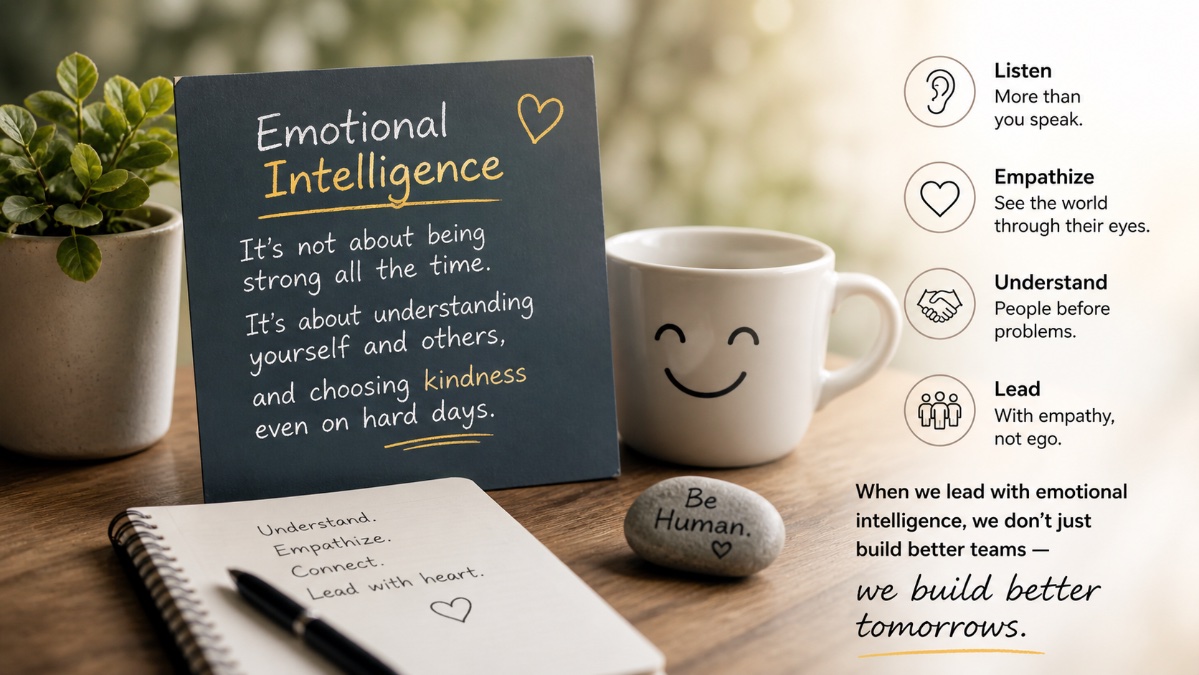
In reality, Emotional Intelligence is one of the most critical leadership skills today.
It’s not about being overly emotional or avoiding tough decisions.
It’s about being aware.
Aware of:
- Your own reactions
- Your tone
- The energy you bring into a room
And more importantly, aware of:
- What your team members are feeling
- What they are not saying
- What they actually need
What I Learned the Hard Way
Here are a few lessons that changed my perspective completely:
1. People Don’t Leave Work. They Leave How Work Makes Them Feel.
You can have the best projects, the highest salaries, the most exciting opportunities.
But if people feel unheard, undervalued, or constantly pressured they disconnect.
And once that connection is lost, performance follows.
2. Listening is More Powerful Than Talking
As leaders, we often feel the need to provide answers.
But sometimes, what your team needs is not a solution
it’s someone who truly listens.
3. Pressure Creates Output. Understanding Creates Ownership
When people are pushed, they deliver because they have to.
When people feel understood, they deliver because they want to.
And that difference is everything.
4. Small Moments Define Leadership
It’s not always big decisions that define you as a leader.
Sometimes, it’s a simple question.
A pause.
A moment of empathy.
Like asking:
“Are you okay?”
A Message to Leaders, Managers, and CXOs
In today’s world, we talk a lot about:
- AI
- Automation
- Productivity
- Speed
But we often forget one thing:
At the center of every system, every process, every outcome… there are people.
And no technology, no framework, no strategy can replace human connection.
You don’t need to be perfect as a leader.
You don’t need to have all the answers.
But you do need to be present.
You need to:
- Listen without judgment
- Lead with empathy
- Create a safe space for your team
Because at the end of the day…
Your team members may forget what you said in meetings.
They may forget the deadlines you pushed.
But they will never forget
how you made them feel.
Final Thought
That one small moment
a simple conversation at the end of a long day
changed how I see leadership forever.
And if there’s one thing I would say to every leader reading this, it’s this:
Don’t wait for things to break before you connect.
Start now.
Because great teams are not built by pressure.
They are built by trust, empathy, and emotional intelligence.