Risk-Based Testing Explained with Real Examples
By Nikhil Gupta · Published 2026-07-01 · Tools & Resources
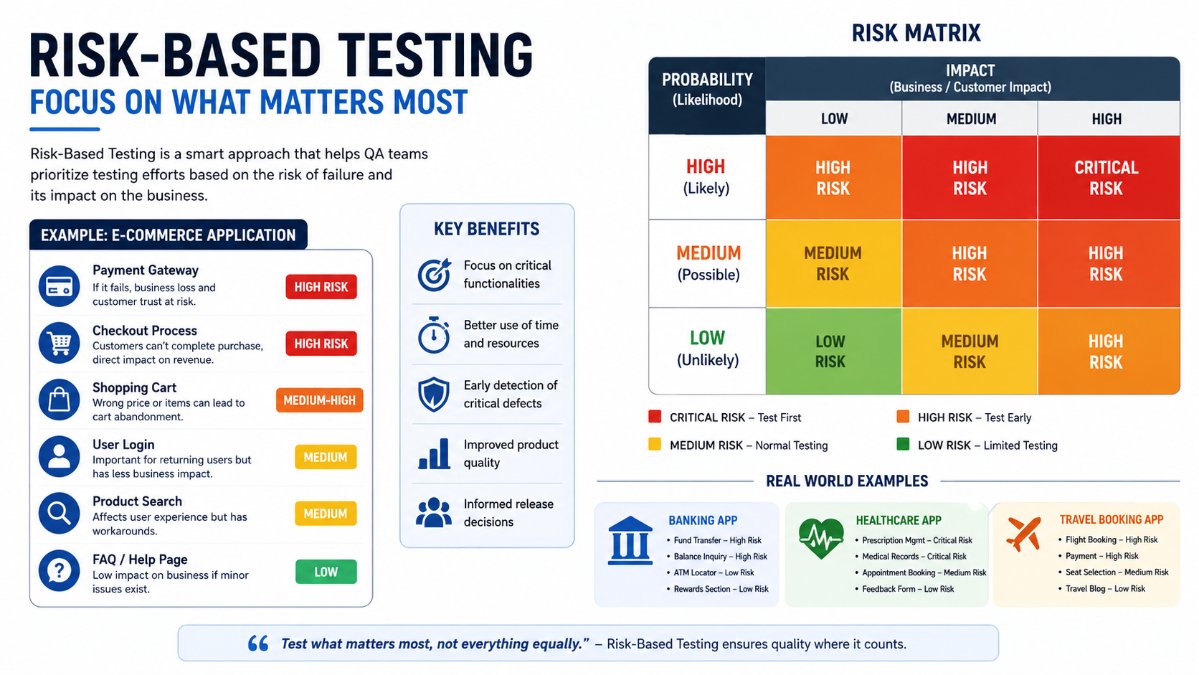
Why Smart QA Teams Test What Matters Most
In today's fast-paced software development environment, testing every feature with the same level of effort is no longer practical. Applications are becoming more complex, release cycles are getting shorter, and customers expect high-quality software delivered quickly. As a result, QA teams need a smarter approach to ensure quality without delaying releases.
This is where Risk-Based Testing (RBT) becomes an invaluable strategy.
Rather than treating every requirement equally, Risk-Based Testing helps teams identify which areas of an application pose the highest business or technical risk and prioritize testing accordingly. It enables QA teams to spend more time testing what matters most while reducing effort on low-risk functionality.
Whether you are a Manual Tester, Test Lead, QA Manager, or Product Owner, understanding Risk-Based Testing can significantly improve product quality, optimize testing efforts, and reduce the chances of critical production defects.
What is Risk-Based Testing?
Risk-Based Testing is a testing approach where the scope, priority, and intensity of testing are determined by the level of risk associated with different parts of an application.
A risk is the possibility that a defect could cause a significant business, financial, security, or customer impact.
Instead of asking:
"What should we test first?"
Risk-Based Testing asks:
"What will hurt the business the most if it fails?"
By answering this question, QA teams can focus on the most critical functionalities first.
Understanding Risk
Risk is generally calculated using two factors:
Risk = Probability × Impact
Probability
Probability measures the likelihood that a defect exists.
Examples include:
- Complex business logic
- Newly developed modules
- Frequently changed code
- Multiple system integrations
- Inexperienced developers
- Tight development timelines
Impact
Impact measures the damage caused if a defect reaches production.
Examples include:
- Financial loss
- Security breach
- Legal or compliance issues
- Customer dissatisfaction
- Brand reputation damage
- Operational downtime
The combination of these two factors determines the overall testing priority.
Real Example 1: E-commerce Application
Imagine your team is testing an online shopping platform before a major festive sale.
The application includes:
- User Login
- Product Search
- Shopping Cart
- Checkout
- Payment Gateway
- Wishlist
- Product Reviews
- FAQ Section
Which modules deserve the most attention?
High-Risk Modules
Payment Gateway
If payment fails or customers are charged incorrectly, the business could lose revenue and customer trust.
Priority: Highest
Checkout Process
Customers unable to complete purchases directly affect sales.
Priority: Highest
Shopping Cart
Incorrect pricing or missing products lead to abandoned purchases.
Priority: High
Medium-Risk Modules
User Login
Important for returning customers, but guest checkout may reduce overall business impact.
Priority: Medium
Product Search
Search issues affect usability but often have workarounds through categories or navigation.
Priority: Medium
Low-Risk Modules
FAQ Page
A formatting issue or broken link is unlikely to prevent purchases.
Priority: Low
Product Reviews
Helpful for customers but not essential for completing transactions.
Priority: Low
In this scenario, if only two days remain before release, QA should spend most of its effort on checkout, payment, and shopping cart functionality rather than cosmetic issues in the FAQ section.
Real Example 2: Banking Application
Now consider a mobile banking application.
Features include:
- Balance Inquiry
- Fund Transfer
- Beneficiary Management
- ATM Locator
- Profile Update
- Rewards Section
The highest-risk areas are obvious.
Fund Transfer errors could result in incorrect transactions, financial losses, regulatory concerns, and customer complaints.
Balance Inquiry must display accurate information because incorrect balances can lead to poor financial decisions.
Beneficiary Management requires strong validation to prevent unauthorized transfers.
On the other hand, the ATM Locator or Rewards section, while useful, generally carries lower business risk.
This prioritization ensures that the most critical financial operations receive the deepest testing before release.
Real Example 3: Healthcare Application
Healthcare systems demand exceptional reliability because software defects can directly affect patient safety.
Consider these modules:
- Patient Registration
- Appointment Booking
- Electronic Medical Records
- Prescription Management
- Billing
- Feedback Form
Prescription Management and Medical Records are extremely high-risk because incorrect information could result in improper treatment or medication errors.
Appointment Booking is important but less critical than patient medical history.
The Feedback Form has relatively low business risk and can receive lighter testing if resources are constrained.
This example highlights that risk is not only about business revenue-it can also involve safety, compliance, and patient well-being.
Factors to Consider When Assessing Risk
Risk assessment should involve multiple stakeholders, not just the QA team.
Common factors include:
- Business criticality
- Customer impact
- Revenue dependency
- Security sensitivity
- Regulatory compliance
- Technical complexity
- Integration with external systems
- Frequency of code changes
- Defect history
- Production incidents
- Performance requirements
- Number of users affected
A collaborative discussion involving Product Owners, Business Analysts, Developers, QA Engineers, and Support Teams usually produces the most accurate risk assessment.
Benefits of Risk-Based Testing
Organizations adopting Risk-Based Testing often experience several advantages.
First, testing effort is focused on the areas that matter most, improving overall efficiency.
Second, critical defects are identified earlier, reducing the likelihood of costly production issues.
Third, release decisions become more data-driven because teams understand which risks have been mitigated and which remain.
Fourth, limited testing resources are used more effectively, allowing teams to maintain quality even under tight deadlines.
Finally, stakeholders gain greater confidence in the release because testing priorities are aligned with business objectives.
Common Mistakes to Avoid
Although Risk-Based Testing is powerful, it can fail if implemented incorrectly.
One common mistake is assuming that every feature is equally critical. If everything is marked as "High Risk," prioritization becomes meaningless.
Another mistake is performing the risk assessment only once. Risks change as development progresses, new features are added, and defects are discovered.
Some teams also ignore business stakeholders during risk assessment. Developers understand technical complexity, but business teams understand customer impact. Both perspectives are essential.
Finally, teams sometimes neglect low-risk features entirely. While these areas require less testing, they should still receive appropriate validation to ensure overall product quality.
Best Practices for Successful Risk-Based Testing
To maximize the benefits of Risk-Based Testing:
- Conduct risk assessment during sprint planning or release planning.
- Involve QA, Development, Product Management, and Business stakeholders.
- Maintain a documented risk register for transparency.
- Reassess risks whenever major changes occur.
- Prioritize exploratory testing for high-risk areas.
- Automate regression tests for critical business flows where possible.
- Review production defects regularly to refine future risk assessments.
Risk-based decisions should evolve with the product rather than remain static.
Final Thoughts
Risk-Based Testing is more than a testing technique-it is a mindset that aligns quality assurance with business priorities.
No project has unlimited time, budget, or resources. Attempting to test everything equally often leads to wasted effort while critical functionality receives insufficient attention.
By understanding the probability of failure and the impact on users or the business, QA teams can make informed decisions, optimize testing efforts, and deliver higher-quality software with greater confidence.
The most successful QA professionals are not those who execute the highest number of test cases. They are the ones who know which test cases matter most.
As software development continues to accelerate, Risk-Based Testing will remain one of the most valuable skills for every Manual Tester, Test Lead, and QA Manager. It enables teams to focus on delivering reliable, secure, and business-critical software-exactly where quality has the greatest impact.