Part 6: Visual Storytelling and Dialogue Craft
By Bhavesh Rathod · Published 2026-06-24 · Industry Insights
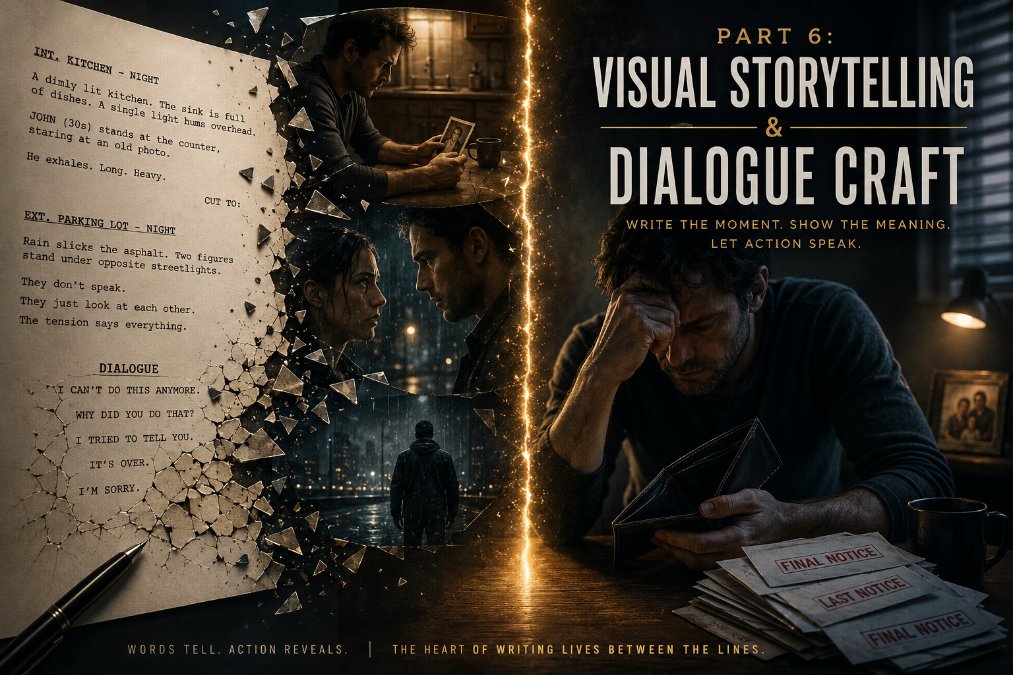
Many aspiring writers believe that a script is driven entirely by what characters say. However, cinema is a visual medium. Part 6 explores how to show your story instead of telling it, and how to write sharp, memorable dialogues that cut through the noise.
1. "Show, Don't Tell" (The Golden Rule)
Never let a character state a fact or an emotion through dialogue if you can convey it through a visual action. Audience retention drops when characters give long expositions about their feelings.
- The Rule: Replace descriptive dialogue with cinematic behavior or environmental details.
- Bad Example (Telling): A character says, "I am ruined and I have absolutely no money left to pay my bills."
- Good Example (Showing): The character sits in a dark room. The camera pans to a stack of red-stamped 'Final Legal Notice' notices on the table, alongside a completely empty wallet. The character slowly switches off the main power switch to save electricity. The visual communicates the desperation immediately.
2. Dialogue is Conflict, Not Conversation
Real-world conversations are filled with polite agreements, pleasantries, and repetition. Cinematic dialogue must be compressed, stylized, and charged with tension. Every line must either advance the plot or reveal character depth.
- The Concept: Avoid "Ping-Pong" dialogue where characters simply answer each other's questions directly. Use evasion, hesitation, or interruption to build drama.
- Technique: If Character A asks a direct question, Character B should reply with a question, a deflection, or complete silence. This keeps the audience guessing about the true dynamics between them.
3. The Power of Silence (The Unsaid Beats)
Sometimes, the most powerful dialogue in a feature-length screenplay is no dialogue at all. Relying on beats, pauses, and expressions forces the audience to engage deeply with the character's internal struggle.
- Example: After a massive argument, instead of having a character shout a final insult, show them staring at the other person, taking a long beat, turning around, and quietly closing the door. The quietness of the exit amplifies the weight of the separation.
4. Direct vs. Indirect Dialogue (Voice and Rhythm)
Every character must possess a distinct linguistic identity based on their background, education, and regional roots. Do not make all characters sound like the writer.
- The Approach: Use specific vernacular rhythms, slang, or pacing depending on who is speaking. A rural worker from a coastal district will structure their thoughts and metaphors entirely differently compared to a corporate professional from a metro city. Match the vocabulary to the character's lived experience to establish absolute authenticity.
Conclusion: Writing for the Camera
When your visuals do the heavy lifting and your dialogues are sharp, concise, and filled with conflict, your script transforms from a mere text document into a blueprint for cinema. Producers and directors look for this specific visual maturity because it translates effortlessly onto the big screen.