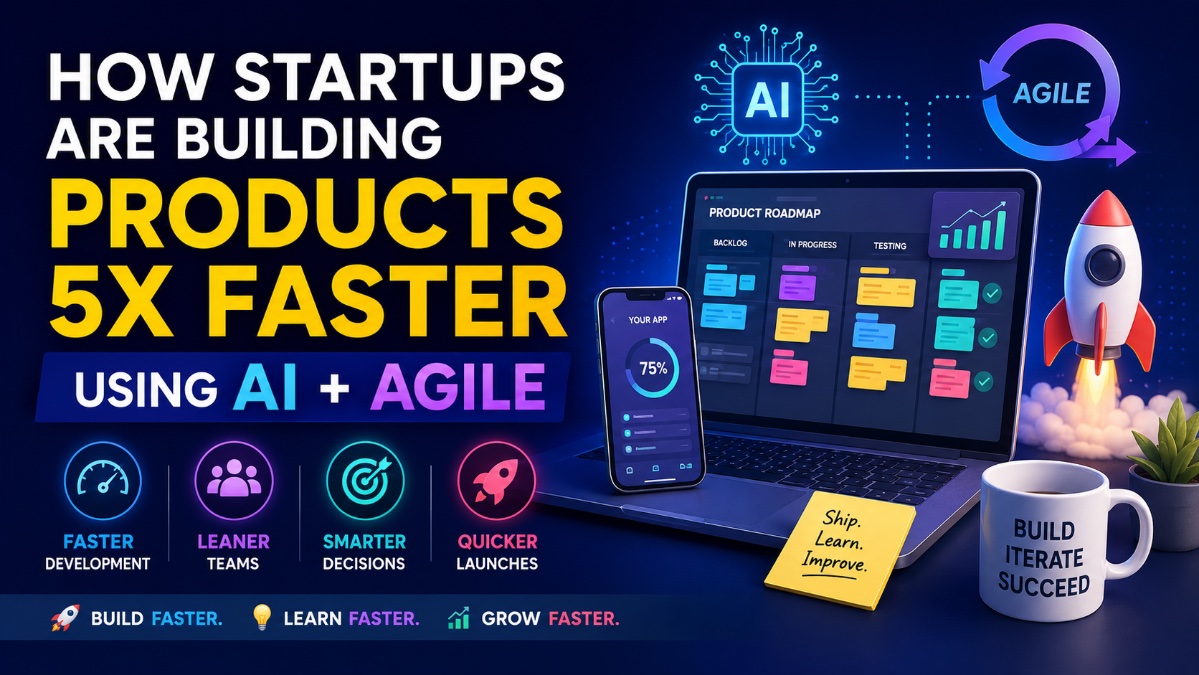
How Startups Are Building Products 5x Faster Using AI + Agile
By Anshul Gupta · Published 2026-05-07 · Technology & Innovation
The startup world has changed forever.
A few years ago, building a successful product required:
- large engineering teams,
- expensive infrastructure,
- months of development,
- endless meetings,
- and huge funding rounds.
Today, a small startup with just a handful of people can build, launch, market, and scale products faster than companies with hundreds of employees.
Not because they work harder.
But because they work smarter.
Artificial Intelligence and Agile development are creating a completely new way of building products. Startups are no longer spending years trying to create “perfect software.” Instead, they are launching quickly, learning from users, improving continuously, and scaling at unbelievable speed.
And honestly, this shift is bigger than most people realize.
Right now, founders sitting in small apartments, coffee shops, or shared coworking spaces are building products that compete directly with established companies.
What once required:
- a development agency,
- separate QA teams,
- designers,
- content creators,
- marketers,
- and huge budgets…
can now be achieved by lean AI-powered teams.
This is not some future prediction anymore.
It is already happening.
And the startups that understand this shift early are gaining a massive advantage.
The Startup Problem
Most startups do not fail because the idea is bad.
They fail because they move too slowly.
Traditional product development has always been painfully time-consuming.
A founder gets an idea.
Then begins the long process:
- researching competitors,
- hiring developers,
- creating designs,
- writing documentation,
- fixing bugs,
- conducting testing,
- planning launches,
- and waiting endlessly for product releases.
Months pass.
Money burns.
Stress increases.
And often, before the product even launches properly, competitors move ahead.
This is one of the biggest reasons startups struggle.
Speed matters more than ever.
Because in today’s digital world:
- trends change quickly,
- customer expectations evolve rapidly,
- and markets move incredibly fast.
The companies that adapt faster usually win.
And this is exactly where AI + Agile becomes powerful.
Why AI + Agile Is Becoming the Ultimate Startup Formula
AI alone is not enough.
Agile alone is not enough.
But together?
They create a system where startups can operate at extraordinary speed.
AI provides acceleration.
That combination allows startups to:
- reduce development time,
- automate repetitive tasks,
- improve customer feedback loops,
- and launch products faster than ever before.
The Old Startup Workflow vs Modern AI-Powered Development
A few years ago, launching a digital product looked something like this:
Traditional Startup Workflow
- Idea discussion
- Market research
- Hire designers
- Create wireframes
- Hire frontend developers
- Hire backend developers
- Develop features
- QA testing
- Bug fixing
- Marketing preparation
- Product launch
This process could easily take:
6–12 months.
Sometimes longer.
Now compare that to modern AI-powered startups.
Modern AI + Agile Workflow
- AI-assisted market research
- Rapid wireframe generation
- AI-supported coding
- Automated testing
- AI-generated product documentation
- Agile sprint-based releases
- Continuous user feedback integration
Time taken:
2–6 weeks for an MVP.
That difference changes everything.
How Startups Build SaaS Products Faster Today
Let’s take a practical example.
Imagine a startup wants to build a project management SaaS platform for remote teams.
A few years ago:
- they would need a large engineering team,
- separate UI designers,
- QA testers,
- DevOps engineers,
- marketers,
- and months of planning.
The development process alone could take nearly a year.
Today, the workflow looks completely different.
Week 1 : Research & Product Planning
The startup uses AI tools to:
- analyze competitors,
- identify trending SaaS features,
- generate customer pain points,
- and create feature suggestions.
AI-powered design assistants generate:
- dashboards,
- layout ideas,
- onboarding screens,
- and workflow designs within hours.
Earlier, this stage alone took weeks.
Week 2 : Development Begins
Developers use AI coding copilots to:
- accelerate frontend development,
- generate reusable components,
- build authentication systems,
- and speed up API integration.
Instead of writing every line manually, developers focus more on:
- architecture,
- business logic,
- and user experience.
This dramatically increases productivity.
Week 3 : Testing & Optimization
AI-powered testing tools automatically:
- detect bugs,
- identify performance issues,
- and validate workflows.
At the same time:
- landing pages,
- onboarding emails,
- FAQs,
- and SEO content
are generated rapidly using AI tools.
Earlier, startups needed multiple teams for this stage.
Now smaller teams can handle it efficiently.
Week 4 : Launch & Continuous Improvement
The MVP launches publicly.
Real users begin providing feedback.
Agile sprint cycles help the startup:
- improve features continuously,
- prioritize customer requests,
- and release updates rapidly.
Instead of waiting 6 months for a “big release,” improvements happen weekly.
This creates a massive competitive advantage.
Startups Are No Longer Hiring the Same Way
One of the biggest transformations happening today is team structure.
Earlier, startups required:
- large engineering teams,
- separate content writers,
- support agents,
- designers,
- and extensive QA teams.
Today, AI tools are helping smaller teams achieve far more output.
For example:
- Developers use AI coding assistants.
- Marketers use AI content tools.
- Designers use AI-generated UI inspiration.
- Founders use AI research assistants.
- Support teams automate repetitive customer queries.
This does not mean humans are becoming less valuable.
It means repetitive work is disappearing.
And creativity, problem-solving, and strategic thinking are becoming more important.
Agile Is Helping Startups Escape Perfectionism
One of the biggest startup killers is perfectionism.
Many founders delay launching because they want every feature to be “perfect.”
But customers usually care more about:
- solving a problem,
- ease of use,
- fast updates,
- and responsiveness.
Agile development changed this mindset completely.
Instead of building giant products silently for years, startups now:
- launch small,
- gather feedback,
- improve quickly,
- and evolve continuously.
AI makes this process dramatically faster.
A feature that once required:
- days of coding,
- multiple meetings,
- and long testing cycles
can now be prototyped within hours.
This speed allows startups to experiment more fearlessly.
AI Is Reducing Fear for Founders
Starting a company used to feel overwhelming.
Many founders delayed ideas because they lacked:
- funding,
- technical teams,
- marketing resources,
- or operational support.
AI is reducing many of those barriers.
Today, founders can:
- create prototypes,
- generate product ideas,
- build MVPs,
- automate workflows,
- create marketing campaigns,
- and launch websites…
without needing huge teams initially.
This creates something powerful:
confidence.
And confidence leads to action.
That is why we are seeing more:
- solo founders,
- indie hackers,
- bootstrapped startups,
- and small remote teams
launching products faster than ever before.
The Rise of Tiny Teams With Massive Output
One of the most fascinating trends in modern startups is this:
Small teams are achieving massive results.
Why?
Because AI removes operational bottlenecks.
A 5-person startup today can:
- build software rapidly,
- create daily content,
- automate support,
- manage social media,
- analyze customer behavior,
- and improve products continuously.
Earlier, this required entire departments.
Now lean teams can compete globally.
This is also changing how investors evaluate startups.
Investors are increasingly seeing companies reach impressive revenue milestones with:
- fewer employees,
- lower operational costs,
- and faster execution cycles.
Efficiency is becoming one of the most valuable business advantages.
AI Is Transforming Software Development Culture
Developers are experiencing a huge shift too.
Earlier, coding meant manually writing almost everything.
Today, developers increasingly work like:
- architects,
- reviewers,
- system thinkers,
- and AI collaborators.
The role of software engineers is evolving rapidly.
The best developers today are not simply the fastest coders.
They are the people who:
- understand business problems,
- think strategically,
- guide AI effectively,
- and design scalable systems.
AI is not replacing strong developers.
It is amplifying productive developers.
And that difference matters.
Customer Feedback Loops Are Faster Than Ever
In traditional software companies:
- collecting feedback took months,
- product updates were slow,
- and releases were infrequent.
Today, startups gather customer insights almost instantly.
AI tools help analyze:
- user reviews,
- support tickets,
- customer complaints,
- and feature requests.
Agile teams then rapidly convert those insights into improvements.
This creates a powerful loop:
- Launch quickly
- Gather feedback
- Improve rapidly
- Repeat continuously
The faster this cycle becomes, the faster startups grow.
AI Is Also Revolutionizing Startup Marketing
Building a product is only half the challenge.
Marketing matters equally.
And AI is transforming this area too.
Modern startups now use AI for:
- SEO optimization,
- blog creation,
- social media content,
- email campaigns,
- product descriptions,
- ad copy,
- and customer communication.
A founder can now generate:
- a blog article,
- LinkedIn content,
- social media posts,
- newsletters,
- and launch announcements
from one core idea within hours.
This level of speed was almost impossible before.
But Speed Alone Can Become Dangerous
There is also a hidden risk.
Some startups now move so quickly that:
- quality suffers,
- security weakens,
- and user trust declines.
AI can accelerate mistakes too.
This is why Agile discipline still matters deeply.
The best startups are not blindly depending on AI.
They combine:
- human review,
- testing,
- customer empathy,
- strategic thinking,
- and responsible development practices.
AI should enhance intelligence.
Not replace responsibility.
That balance is critical.
Human Connection Still Matters Most
Despite all the excitement around AI, one truth remains unchanged:
People buy products that understand people.
AI can automate workflows.
But it cannot fully replace:
- empathy,
- emotional understanding,
- creativity,
- and genuine human experiences.
The startups winning today are combining:
- AI speed,
- Agile execution,
- and human-centered thinking.
Because customers do not remember:
how fast your product was coded.
They remember:
how your product made them feel.
And that emotional connection still belongs to humans.
Examples of AI + Agile in Modern Startups
Example 1 : Mobile App Development
AI tools now help startups:
- generate UI layouts,
- accelerate coding,
- automate testing,
- and optimize app performance.
Agile sprint cycles allow apps to improve continuously after launch.
Example 2 : SaaS Website Development
Startups use AI for:
- landing page generation,
- SEO optimization,
- chatbot creation,
- onboarding flows,
- and rapid feature deployment.
This dramatically reduces launch timelines.
Example 3 : Game Development
AI is helping gaming startups:
- generate characters,
- create environments,
- speed up asset creation,
- and automate repetitive design tasks.
Small gaming studios can now compete with larger teams more effectively.
Example 4 : Customer Support Automation
AI chat systems handle repetitive questions instantly while human agents focus on emotional and complex interactions.
This improves:
- response time,
- scalability,
- and customer satisfaction.
Why Startups That Ignore AI May Struggle
This does not mean every startup must become “AI-first.”
But startups that completely ignore AI may face serious disadvantages.
Because competitors using AI:
- move faster,
- reduce operational costs,
- launch quicker,
- and adapt rapidly.
The startup ecosystem is becoming increasingly speed-driven.
And AI is now one of the biggest speed multipliers available.
The Future Belongs to Adaptive Startups
The startups that dominate the next decade may not necessarily be:
- the largest,
- the richest,
- or the oldest.
They will likely be the most adaptable.
Adaptability is becoming more important than company size.
Startups that:
- learn quickly,
- experiment rapidly,
- listen to users,
- and evolve continuously
will lead the future.
AI + Agile creates exactly that environment.
Continuous experimentation.
Continuous learning.
Continuous improvement.
Take Away
We are witnessing one of the biggest transformations in startup history.
Artificial Intelligence is not just another productivity tool.
It is reshaping:
- software development,
- startup operations,
- marketing,
- customer support,
- hiring,
- and innovation speed itself.
Combined with Agile methodologies, startups are now building products at speeds that once felt impossible.
But the real winners will not simply be the companies using AI blindly.
The winners will be the startups that combine:
- AI efficiency,
- Agile flexibility,
- human creativity,
- emotional intelligence,
- and deep customer understanding.
Because technology may accelerate businesses…
but human understanding still builds great products.
And perhaps that is the most important lesson of all.
The future does not belong to AI alone.
It belongs to humans who know how to use it wisely.