AI Does the Work. Humans Own the Outcome: Introducing the AgileAiPro Framework
By Anshul Gupta · Published 2026-08-09 · Technology & Innovation
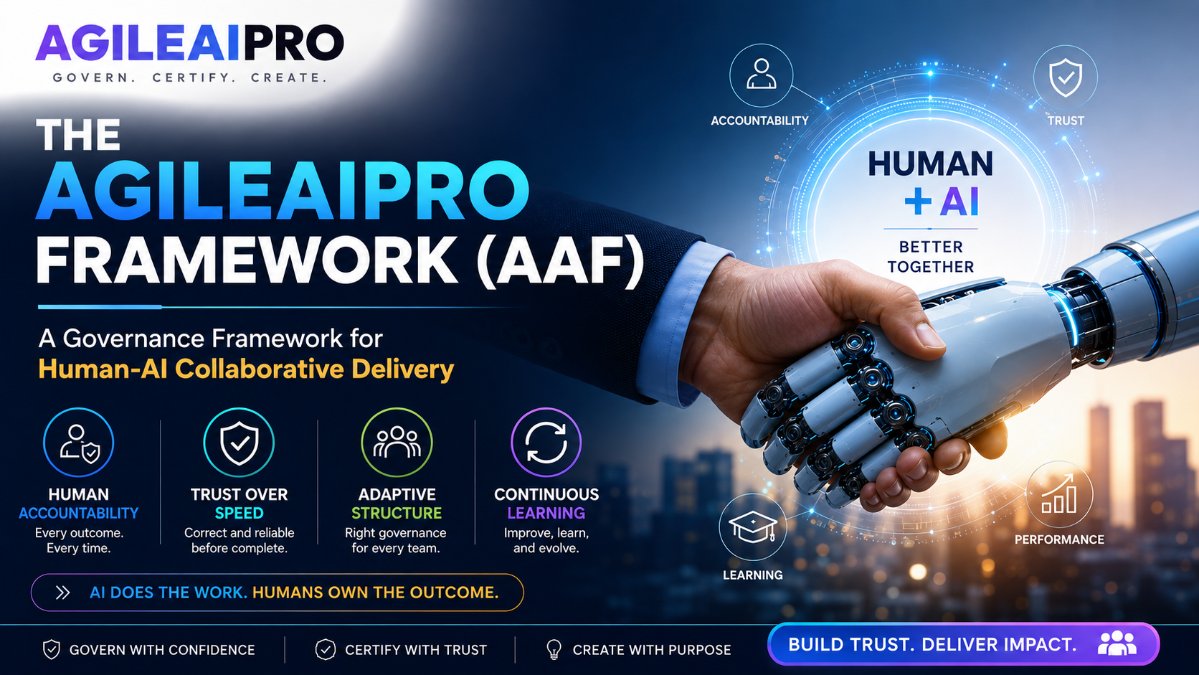
The AgileAiPro Framework (AAF): The Missing Operating System for Human-AI Collaboration
AI Is Changing How Work Gets Done. But Who Owns the Outcome?
Artificial Intelligence has moved beyond being a productivity tool.
Today, AI writes code, drafts client emails, creates marketing campaigns, generates reports, analyzes data, and even recommends business decisions.
The question is no longer:
"Can AI do the work?"
The real question is:
"Who is accountable when AI does the work?"
This is the challenge organizations everywhere are facing.
While AI adoption is accelerating, governance is lagging behind.
Teams are using ChatGPT, Claude, Gemini, Copilot, and dozens of other AI tools every day. Yet most organizations still rely on delivery frameworks that were designed before generative AI existed.
That's exactly why the AgileAiPro Framework (AAF) was created.
What Is the AgileAiPro Framework (AAF)?
The AgileAiPro Framework (AAF) is a governance framework designed specifically for the age of Human-AI collaboration.
Unlike Agile, Scrum, Kanban, or SAFe, AAF does not replace your existing way of working.
Instead, it sits on top of your current delivery model and introduces the governance, accountability, trust, and review mechanisms required when AI becomes part of the workforce.
Whether you're:
- A software company
- A consulting organization
- A bank
- A healthcare provider
- A marketing agency
- A manufacturing enterprise
- A government department
AAF provides a structured approach to ensure AI-generated work remains accurate, trustworthy, and accountable.
Why Existing Frameworks Are No Longer Enough
Agile transformed software delivery.
Scrum improved team collaboration.
Kanban optimized workflow visibility.
But all of these frameworks were built on one assumption:
Every contributor is human.
That assumption no longer holds true.
Today:
- AI writes production code.
- AI generates customer communications.
- AI drafts contracts.
- AI creates business reports.
- AI influences operational decisions.
When AI makes a mistake, organizations often discover they have no clear answer to questions like:
- Who approved the output?
- Who reviewed it?
- Who owns the risk?
- How do we measure AI quality?
- How do we prevent the same mistake from happening again?
AAF addresses these gaps directly.
The Three Big Problems Organizations Face with AI
1. Nobody Owns the Mistake
An AI-generated email goes to a customer with incorrect pricing.
Who was responsible?
The person who clicked send?
The AI?
The manager?
Most organizations don't have a clear answer.
2. Speed Creates a False Sense of Confidence
AI can produce work in seconds.
But speed doesn't equal accuracy.
Fast and wrong is still wrong.
AAF introduces governance mechanisms that ensure trust is measured alongside productivity.
3. Review Happens Too Late
Many teams only review AI-generated work after it reaches customers.
By then, the damage may already be done.
AAF introduces structured review checkpoints that catch issues before release.
The Core Philosophy Behind AAF
The framework is built on four foundational values:
Human Accountability Over AI Autonomy
AI can assist.
AI can accelerate.
AI can generate.
But a human must always remain accountable.
Trust Over Raw Speed
Completing work quickly means nothing if the outcome is inaccurate.
Adaptive Structure Over Fixed Rules
A startup with five employees shouldn't operate the same way as a multinational enterprise.
Continuous Governance Over Periodic Audits
Governance should happen daily-not once a year.
The Human-AI Collaboration Model
One of AAF's most powerful concepts is task classification.
Every task is categorized before work begins as:
Human-Led
Humans perform the work.
AI may provide limited assistance.
AI-Led
AI performs most of the work.
Humans review outcomes.
Shared
Humans and AI collaborate together.
This simple classification dramatically improves accountability and transparency.
The New Roles Every AI-Powered Team Needs
AAF introduces governance roles specifically designed for AI-enabled organizations.
Trust Lead
The Trust Lead monitors the health of Human-AI collaboration.
Their focus isn't people.
Their focus is process quality, AI effectiveness, and emerging risk patterns.
Task Owner
The Task Owner determines whether work should be:
- Human-led
- AI-led
- Shared
before execution begins.
Reviewer
The Reviewer provides final approval for high-risk and customer-facing AI-generated outputs.
This creates a clear accountability checkpoint before release.
Compliance Partner
For regulated industries such as:
- Banking
- Healthcare
- Insurance
- Government
AAF introduces a Compliance Partner responsible for ensuring AI usage aligns with regulatory requirements.
The Five Ceremonies That Keep AI Under Control
AAF introduces five lightweight governance ceremonies.
1. Planning Check
Identify tasks.
Tag work.
Highlight risks.
2. Daily Update
Capture progress and AI-related concerns.
3. Midpoint Check
Review whether AI-led work is producing acceptable outcomes.
4. Review
Assess completed work before release.
5. AI Retrospective
Analyze what AI did well and where it failed.
Then improve the process for the next cycle.
Measuring AI Success: Beyond Productivity
Most organizations track speed.
AAF tracks trust.
The framework introduces three key metrics:
Trust Score
Measures completed work, accuracy, and rework effort.
AI Error Rate
Measures how often AI-generated outputs require correction.
Override Rate
Measures how often humans reject or modify AI recommendations.
These metrics help organizations optimize AI adoption without sacrificing quality.
Why AAF Works Across Every Industry
One of the most innovative aspects of AAF is that it is industry-agnostic.
The framework can be applied across:
- Software Development
- Consulting
- Banking
- Healthcare
- Manufacturing
- Retail
- E-Commerce
- Travel
- Education
- Government
- Telecommunications
- Professional Services
The roles remain the same.
The ceremonies remain the same.
Only the risk definitions and review requirements change.
The Future of AI Governance
Most organizations are currently focused on AI adoption.
Very few are focused on AI governance.
History shows that every technological revolution eventually requires standards, operating models, and accountability structures.
The organizations that build governance today will become the trusted leaders of tomorrow.
AAF is not trying to slow down AI.
AAF is making AI scalable.
It ensures organizations can move faster while maintaining trust, accountability, compliance, and quality.
Final Thoughts
AI is no longer a future technology.
It is already part of the workforce.
The challenge organizations face isn't whether to use AI.
The challenge is learning how humans and AI can work together responsibly.
The AgileAiPro Framework (AAF) provides a practical answer.
It introduces accountability where none exists.
It creates trust where uncertainty exists.
And it helps organizations build a repeatable model for Human-AI collaboration in the AI era.
As AI becomes embedded into every business process, governance will become just as important as innovation.
The organizations that master both will define the next generation of business excellence.
The future isn't Human vs AI.
The future is Human + AI, governed by trust.