When Marketing Knows You Better Than You Know Yourself Marketing used to be about persuasion.
By annushree279000 · Published 2026-05-02 · Marketing & Growth
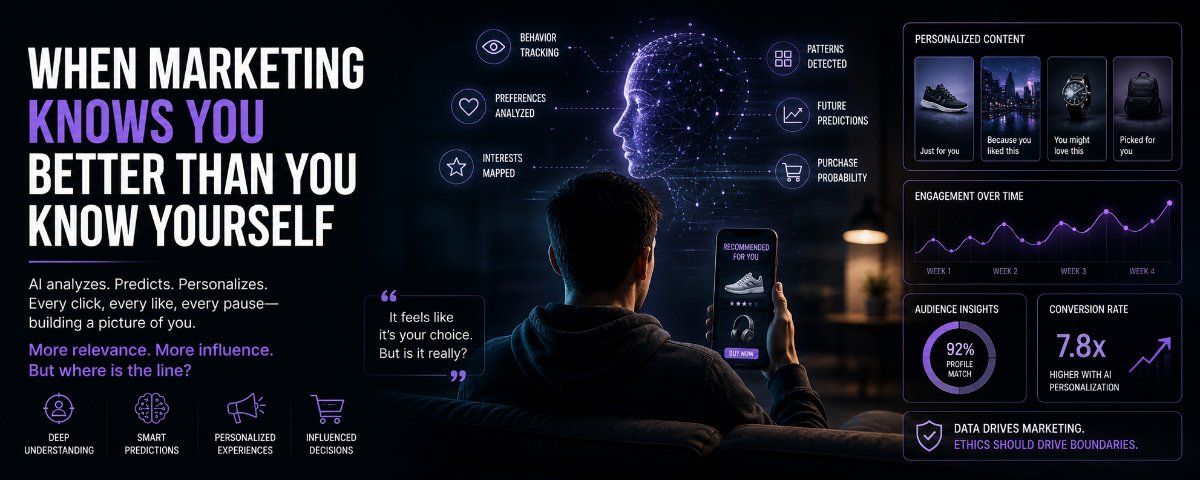
Marketing used to be about persuasion.
Brands created messages, told stories, and tried to capture attention. They guessed what people might like, tested different approaches, and slowly refined their strategies over time.
There was always some level of uncertainty.
Today, that uncertainty is disappearing.
Artificial intelligence is turning marketing into something far more precise. It is no longer just about reaching people. It is about understanding them, predicting them, and sometimes influencing them before they even realize what they want.
The Shift From Targeting to Knowing
Traditional marketing relied on segments.
Age groups. Locations. Interests.
It worked with broad assumptions. A campaign designed for a group of people, hoping it would resonate with at least some of them.
AI changes that completely.
Now, marketing systems analyze individual behavior. What you click, how long you stay, what you ignore, what time you are most active, even how your preferences change over time.
This is not just targeting.
It is pattern recognition at a personal level.
Over time, the system builds a version of you that is detailed, consistent, and constantly updated.
In some cases, it becomes more predictable than you are.
The Power of Prediction
One of the most powerful aspects of AI in marketing is prediction.
It does not just react to what you have done. It anticipates what you might do next.
What you might buy.
What you might search.
What you might feel drawn to.
This changes the entire dynamic.
Instead of waiting for demand, businesses can shape it. Instead of responding to interest, they can create it.
The line between discovery and suggestion begins to blur.
You feel like you are choosing.
But often, you are being guided.
When Personalization Becomes Intimate
Personalization has always been a goal in marketing.
But AI takes it to a different level.
Messages are no longer just relevant. They feel personal.
An ad appears at the right moment. A product recommendation aligns perfectly with your current mood. A piece of content feels like it was made specifically for you.
This creates a sense of connection.
But it also raises a question.
At what point does personalization become intrusion?
When a system understands your behavior deeply enough, it can influence decisions in ways that feel natural, even when they are not entirely your own.
The Illusion of Choice
One of the most subtle effects of AI-driven marketing is the illusion of choice.
You scroll, you browse, you explore.
It feels like freedom.
But the options you see are not random. They are curated. Filtered. Ranked.
AI decides what appears first, what stands out, and what disappears.
This does not remove choice entirely, but it shapes it.
The decisions you make are influenced by what you are shown, and what you are shown is determined by a system designed to optimize engagement.
Over time, this can create a feedback loop.
You see what you are likely to like.
You engage with it.
The system learns and reinforces it.
Your world becomes more predictable.
And less diverse.
Marketing Without Creativity?
There is another shift happening beneath all this.
As AI becomes more capable, marketing is becoming more efficient. Campaigns are generated faster. Content is produced at scale. Strategies are optimized in real time.
But efficiency does not always lead to creativity.
When everyone uses similar tools, the outputs begin to resemble each other. Messaging becomes polished, but familiar. Campaigns become effective, but less distinctive.
Originality requires risk, experimentation, and sometimes failure.
AI tends to minimize those.
It optimizes for what works, not for what is new.
The Responsibility of Influence
Marketing has always had influence.
But with AI, that influence becomes more precise and more powerful.
This brings responsibility.
If businesses can predict behavior, they can also manipulate it. If they can understand emotional patterns, they can use them to drive decisions.
The question is not whether this will happen.
It already is.
The question is how far it will go.
And whether businesses will set boundaries for themselves.
A New Relationship Between Brands and People
AI is not just changing marketing strategies. It is changing the relationship between businesses and individuals.
Brands are no longer speaking to audiences.
They are interacting with individuals.
This creates opportunities for better experiences, more relevant products, and stronger connections.
But it also creates a dynamic where the balance of power shifts.
The side that understands more has more influence.
Conclusion
Artificial intelligence is making marketing smarter, faster, and more precise.
It is turning guesswork into prediction and broad messaging into deeply personalized interaction.
But in doing so, it is also raising important questions.
About choice.
About influence.
About how much we are willing to be understood.
Because when marketing knows you better than you know yourself, the conversation is no longer just about selling.
It becomes about control.