Efficiency Is Killing Creativity in Business
By annushree279000 · Published 2026-05-02 · Finance & Business
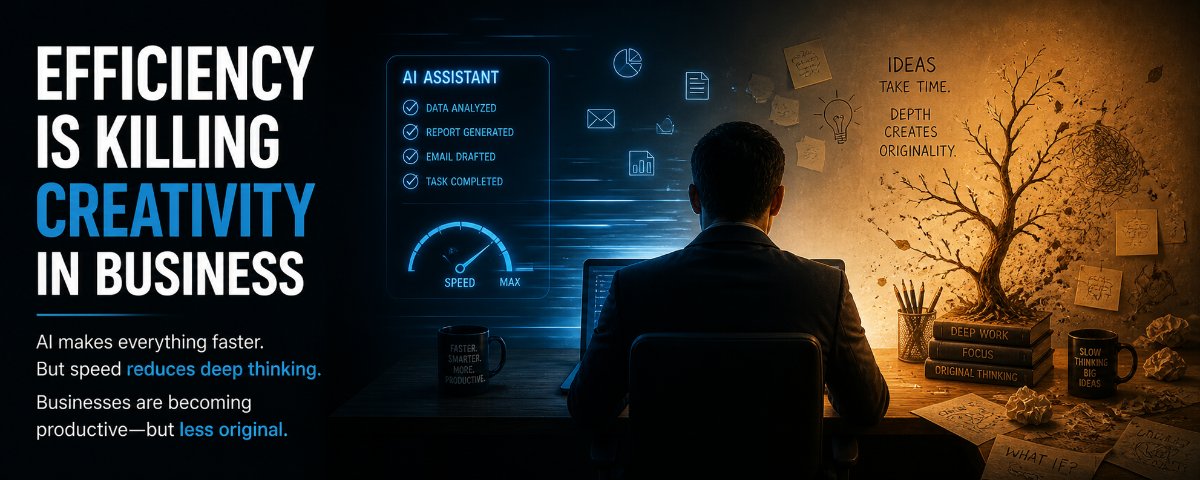
There is a quiet obsession in modern business.
Speed.
Faster execution. Faster decisions. Faster results.
Somewhere along the way, efficiency stopped being a goal and became the standard by which everything is judged. If something can be done quicker, it is automatically seen as better.
And now, with artificial intelligence, speed is no longer a limitation.
It is the default.
But there is something we are not noticing while everything accelerates.
Creativity is slowing down.
The Rise of Effortless Work
Artificial intelligence has made work feel lighter.
You can draft emails in seconds. Generate reports instantly. Create presentations without starting from scratch. Ideas that once took hours now take minutes.
On the surface, this feels like progress.
Less effort. More output. Better productivity.
Businesses are getting more done in less time, and that is often celebrated as success.
But there is a difference between doing more and thinking more.
And that difference is starting to matter.
When Speed Replaces Depth
Creativity does not work well under pressure to be fast.
It requires time to explore, to question, to sit with uncertainty. The best ideas rarely appear fully formed. They evolve slowly, often through confusion, trial, and reflection.
When everything becomes about speed, that process gets shortened.
Instead of asking deeper questions, we start accepting the first good answer. Instead of exploring multiple directions, we choose the quickest viable one.
AI makes this easier.
It provides immediate responses, immediate ideas, immediate solutions.
And when answers are always available instantly, the habit of thinking deeply begins to fade.
The Comfort of “Good Enough”
One of the most subtle effects of AI in business is the rise of “good enough.”
AI-generated content is often polished, structured, and acceptable. It meets the standard. It does the job.
But it rarely pushes boundaries.
When businesses rely heavily on these outputs, they begin to settle. The goal shifts from creating something exceptional to producing something that works.
Over time, this creates a landscape where everything looks fine, but nothing feels original.
Different companies start sounding the same. Campaigns begin to resemble each other. Ideas lose their distinct voice.
Efficiency increases.
Originality decreases.
The Disappearance of Creative Struggle
There is a part of creativity that is uncomfortable.
The part where ideas do not come easily. Where nothing feels right. Where you spend hours thinking and still feel uncertain.
That struggle is not a flaw.
It is part of the process.
It forces deeper thinking. It pushes you to go beyond obvious solutions. It is often where the most original ideas come from.
AI removes much of that struggle.
It fills the gaps quickly. It offers solutions before you have fully explored the problem.
While this makes work smoother, it also removes the tension that often leads to innovation.
Without that tension, creativity becomes flatter.
Businesses Are Getting Faster, Not Better
This is the paradox.
Companies are becoming more efficient than ever. They are producing more content, making quicker decisions, and responding faster to change.
But speed is not the same as progress.
When every business has access to similar tools and similar outputs, the competitive advantage shifts. It is no longer about who can do things faster, because everyone can.
It becomes about who can think differently.
And that is exactly what is being reduced.
The Illusion of Innovation
Many businesses believe they are becoming more innovative because they are using advanced technology.
But using AI does not automatically lead to innovation.
In fact, it can create an illusion of creativity.
When ideas are generated quickly and presented well, they feel impressive. But if they are based on existing patterns, they are not truly new. They are variations of what already exists.
Real innovation requires stepping outside those patterns.
And that requires time, discomfort, and depth.
Three things efficiency tends to eliminate.
Rethinking What We Value
This does not mean that efficiency is wrong.
AI is powerful. It saves time. It removes repetitive work. It allows businesses to operate at a scale that was not possible before.
The problem is not efficiency itself.
The problem is when efficiency becomes the only thing we value.
If businesses measure success only by speed and output, creativity will continue to decline. But if they begin to value depth, originality, and thoughtful work, the balance can shift.
It requires intention.
Choosing to pause when everything encourages speed.
Choosing to think when answers are already available.
Choosing to create, not just generate.
A Slower Kind of Advantage
In a world where everything is fast, slowness can become an advantage.
Not slowness in execution, but slowness in thinking.
Taking time to question ideas. To explore alternatives. To go beyond what is immediately available.
This is where originality lives.
And in the long run, originality is what sets businesses apart.
Conclusion
Artificial intelligence is making businesses faster, more efficient, and more productive.
But it is also quietly reshaping how we think.
When speed becomes the priority, depth begins to disappear. And when depth disappears, creativity follows.
The future of business will not be defined only by how quickly things are done, but by how thoughtfully they are created.
Because in the end, being fast is easy.
Being original is not.