Best Automation Testing Tools Every QA Should Learn
By Nikhil Gupta · Published 2026-05-02 · Tools & Resources
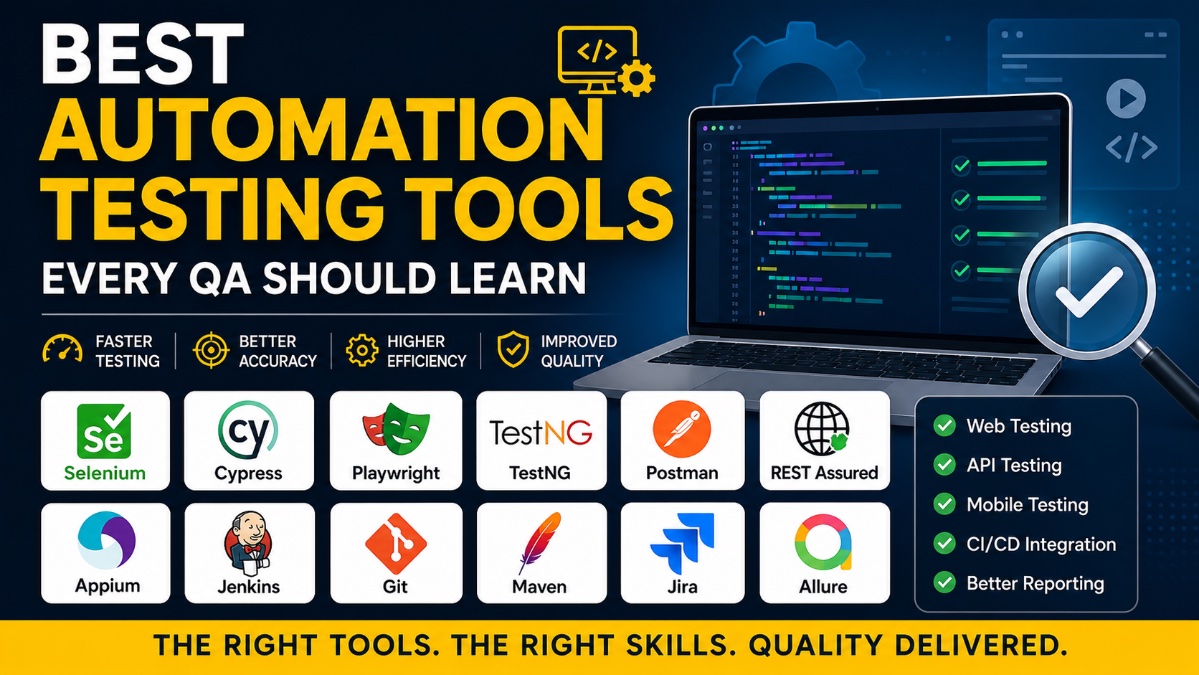
If you’ve been in testing for even a short time, you’ve probably heard this more than once:
“You need to learn automation to stay relevant.”
And honestly, that’s not wrong but it’s also not the full story.
Automation isn’t just about learning tools. It’s about thinking differently how to reduce manual effort, how to improve reliability, and how to deliver faster without compromising quality.
The challenge most QA engineers face today isn’t whether to learn automation it’s which tools actually matter. There are dozens out there, and trying to learn all of them is neither practical nor necessary.
So instead of overwhelming you, let’s focus on the tools that truly add value the ones that can make a real difference in your day-to-day work and long-term career.
Why Automation Tools Matter More Than Ever
Before we jump into the tools, let’s take a moment to understand the shift.
Modern development is faster than ever. With Agile and DevOps practices, releases happen weekly, sometimes even daily. In such environments, relying only on manual testing is simply not scalable.
Automation helps you:
- Run tests faster and more frequently
- Catch bugs early
- Improve test coverage
- Reduce repetitive work
But here’s the important part automation is not about replacing testers. It’s about empowering them to focus on what truly matters: thinking, exploring, and improving quality.
1. Selenium – The Foundation You Can’t Ignore
Let’s start with the classic.
Selenium has been around for years, and despite new tools entering the market, it remains one of the most widely used automation frameworks.
Why? Because it’s flexible, open-source, and supports multiple programming languages like Java, Python, and JavaScript.
Selenium is not a plug-and-play tool. It requires some setup and coding knowledge. But once you understand it, you gain strong fundamentals in automation testing.
It teaches you how automation really works behind the scenes locators, waits, browser interactions, and framework design.
If you’re serious about automation, Selenium is still a great starting point.
2. Cypress – Fast, Modern, and Developer-Friendly
Cypress has gained massive popularity in recent years, especially among modern web application teams.
What makes Cypress stand out is its simplicity and speed. It’s built specifically for modern JavaScript-based applications and offers a very smooth developer experience.
Unlike Selenium, Cypress runs directly in the browser, which makes debugging much easier. You can actually see your tests running in real time.
It’s ideal for:
- Frontend testing
- Fast feedback loops
- Teams working heavily with JavaScript
If you want a tool that feels modern and intuitive, Cypress is definitely worth learning.
3. Playwright – The Rising Star
Playwright is quickly becoming a favorite among QA engineers and developers.
Created by Microsoft, it supports multiple browsers (Chromium, Firefox, WebKit) and allows cross-browser testing with a single API.
What makes Playwright powerful is its reliability and advanced capabilities:
- Auto-waiting for elements
- Handling multiple tabs and contexts
- Built-in support for network interception
It also supports multiple languages, which gives flexibility to teams.
Many teams are now moving from Selenium to Playwright because it reduces flakiness and improves test stability.
If you’re planning for the future, Playwright is a smart investment.
4. TestNG / JUnit – The Backbone of Test Frameworks
While tools like Selenium, Cypress, and Playwright handle browser interactions, frameworks like TestNG and JUnit help you structure your tests.
They provide features like:
- Test organization
- Reporting
- Parallel execution
- Annotations for better control
Think of them as the foundation that keeps your automation clean and maintainable.
Without a proper framework, even the best automation scripts can become messy and hard to manage.
5. Postman / REST Assured – API Testing Essentials
UI testing is important, but modern applications rely heavily on APIs.
And here’s the truth-API tests are faster, more stable, and easier to maintain than UI tests.
Postman is a great starting point for beginners. It allows you to:
- Send API requests
- Validate responses
- Automate test collections
For more advanced automation, REST Assured (Java-based) is widely used.
Learning API testing tools gives you an edge because you’re not just testing the surface-you’re validating the core functionality of the system.
6. Appium – For Mobile Testing
With mobile applications growing rapidly, mobile automation is becoming a valuable skill.
Appium allows you to automate both Android and iOS applications using a single framework.
It works similarly to Selenium, which makes it easier to learn if you already have web automation experience.
If your project involves mobile apps, Appium is a must-have in your toolkit.
7. Jenkins – Automation in CI/CD
Automation is not just about writing test scripts it’s about integrating them into the development pipeline.
Jenkins is one of the most widely used tools for Continuous Integration and Continuous Delivery (CI/CD).
It helps you:
- Run automated tests on every code change
- Schedule test executions
- Generate reports
- Ensure faster feedback
Without CI/CD integration, automation loses its real power.
8. Git – Version Control for Testers
This might not sound like a testing tool, but it’s absolutely essential.
Git helps you:
- Manage your test scripts
- Collaborate with teams
- Track changes
In modern teams, every QA engineer is expected to understand basic Git operations.
It’s not optional anymore it’s part of the job.
Choosing the Right Tool
One of the biggest mistakes testers make is chasing tools.
They jump from Selenium to Cypress to Playwright without mastering any of them.
Here’s a better approach:
- Start with one core tool (Selenium or Playwright)
- Learn API testing alongside it
- Understand frameworks and CI/CD
- Then explore other tools based on your project needs
Remember, tools will keep changing.
But your understanding of testing concepts, automation logic, and problem-solving that’s what truly matters.
The Bigger Picture
Automation is not about writing scripts.
It’s about:
- Thinking like a user
- Understanding the system
- Identifying risks
- Ensuring quality at speed
Tools are just enablers.
A good tester with basic tools will always outperform someone who knows many tools but lacks understanding.
I am thinking...
The world of testing is evolving, and automation is no longer optional it’s essential.
But don’t let that overwhelm you.
You don’t need to learn everything at once.
You just need to start.
Pick one tool.
Build small projects.
Understand how things work.
And most importantly stay consistent.
Because in the end, it’s not the number of tools you know that defines you as a QA engineer…
It’s the value you bring to the team.